Author
Books like Stanisław Lem
8 books we recommend to Stanisław Lem readers, drawn from Solaris, His Master's Voice, The Futurological Congress and The Investigation — each with the reason why.
If you loved Solaris
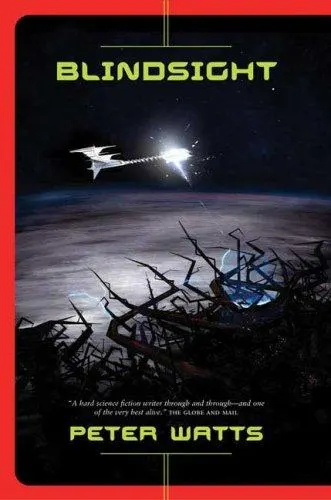
Blindsight takes the intellectual challenge of Solaris and turns it into a ruthless assault on consciousness itself. After an inexplicable visitation, a surgically altered narrator joins a crew of extreme specialists sent to investigate an alien presence at the edge of the solar system. Even among his shipmates, ordinary human psychology has become something strange and difficult to read.
Watts grounds his provocations in cognitive science, evolutionary biology, and unsettling thought experiments, yet the novel’s power comes from how personally it applies them. Its aliens are not disguised humans, and the encounter forces a terrifying question: is self-awareness an evolutionary triumph, or merely an expensive story intelligence tells itself? A Hugo nominee that has become a fiercely defended cult classic, Blindsight is one of the few modern contact novels bold enough to make Solaris feel not imitated, but answered.

On the Six-Thousand Ship, human and humanoid workers give brief statements about their jobs, their memories, and a collection of mysterious objects brought aboard from a planet. Their testimonies gradually produce an eerie collective portrait: sensuous, bureaucratic, funny, and increasingly difficult to divide into human feeling and programmed response.
Where Solaris surrounds an unknowable intelligence with scientific reports, Ravn builds her novel from workplace depositions—small voices circling experiences that official language cannot contain. The objects exert the same kind of pressure as Lem’s ocean: they expose private longing while refusing stable explanation. Shortlisted for the International Booker Prize, this slender Danish novel has earned an ardent readership because it accomplishes in barely more than a hundred pages what much longer science fiction cannot: it makes personhood itself feel alien, fragile, and newly precious.
If you loved His Master's Voice

A fourteen-year-old mathematical prodigy is summoned to a vast research complex to help decode a signal from space. What follows is not a conventional puzzle but a wild satire of organized knowledge: specialists speak mutually unintelligible dialects, committees manufacture urgency, and intellectual brilliance repeatedly collides with the limits of interpretation.
DeLillo gives each discipline its own comic rhythm, making the research establishment feel both absurd and genuinely formidable. Readers who enjoyed Lem’s mixture of technical speculation, institutional mockery, and philosophical unease will recognize a rare kindred work. Often regarded as the strangest and most demanding of DeLillo’s early novels, Ratner’s Star anticipates the encyclopedic ambition of his later masterpieces—and may be the book in which his imagination comes closest to Lem’s.
If you loved The Futurological Congress

Reality begins to malfunction around a group of psychic-security specialists: time slips, objects regress, and an omnipresent commercial product called Ubik offers help in increasingly absurd forms. Like Lem, Dick makes ontological panic inseparable from satire—the same world that may be dissolving still insists on advertising to you.
Widely regarded as one of Dick’s defining novels, Ubik has his rarest combination of virtues: pulp velocity, metaphysical terror, deadpan jokes, and genuine emotional stakes. If The Futurological Congress delighted you by repeatedly pulling the floor out from under Ijon Tichy, Ubik builds an entire funhouse from trapdoors.

An unnamed narrator enters an Irish police station and discovers that ordinary logic has been replaced by an elaborate, serenely administered nonsense involving bicycles, measurements, mysterious machinery, and theories no sane person could invent—or refute. Footnotes on the preposterous philosopher de Selby create a second comic universe beside the first.
This is the recommendation for readers who loved Lem’s language as much as his ideas. O’Brien turns pedantry into surrealism and bureaucratic explanation into a threat; every lucid sentence makes the world less comprehensible. Neglected when written and later embraced as a cult masterpiece, The Third Policeman is one of the indispensable comic novels of metaphysical disorientation.
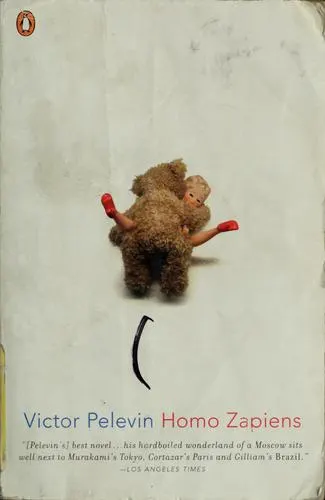
In post-Soviet Moscow, Babylen Tatarsky finds work manufacturing advertisements and political images for a culture rapidly exchanging one compulsory reality for another. Drugs, television, consumer mythology, and ancient symbolism begin to overlap until it becomes difficult to say whether commerce merely represents the world or secretly produces it.
Pelevin, one of the most distinctive voices in post-Soviet fiction, shares Lem’s gift for making philosophy arrive as a savage punchline. Homo Zapiens is less interested in predicting technology than in exposing the machinery that manufactures desire and belief. Its brand names, slogans, hallucinations, and obscene jokes accumulate into a devastating question: if public reality is only another product, who wrote the campaign?
If you loved The Investigation
Dürrenmatt called this compact, ruthless novel a “requiem for the detective novel,” and it earns the phrase. A brilliant inspector refuses to accept the convenient solution to a child’s murder and makes a promise that transforms deduction from a professional method into a consuming moral obligation.
Like Lem, Dürrenmatt asks whether patterns belong to reality or are imposed by minds desperate for coherence. But where The Investigation is cool and spectral, The Pledge is emotionally devastating: it tests the detective’s faith in reason against contingency itself. Few crime novels have dismantled their genre’s comforting machinery so cleanly.
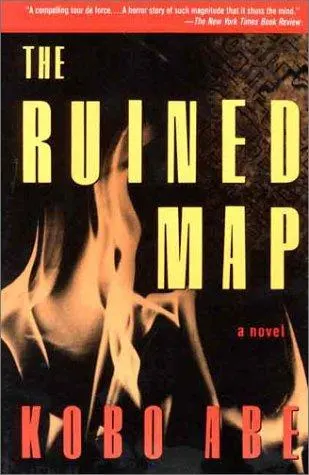
A private investigator is hired to find a missing man, armed with clues that seem concrete yet refuse to compose a stable picture. Every address, photograph, and testimony makes the absent man—and eventually the act of searching for him—more elusive.
Abe’s exact, estranging prose turns ordinary city life into an epistemological trap. This is one of the defining novels of his celebrated postwar avant-garde period: a detective story whose true mystery is how identity can be verified at all. Readers who loved Lem’s patient erosion of the boundary between fact and interpretation will find Abe’s labyrinth almost impossible to shake.