
Books like Ratner's Star
J R turns institutional language into runaway music; His Master’s Voice asks whether language can carry knowledge at all. Between those poles, White Light makes mathematics itself deliriously tangible. Each reaches the territory Ratner’s Star occupies so brilliantly: intellect pushed past mastery into comedy, strangeness, and awe.
If you liked Ratner's Star, you’ll love these
Not lookalikes — kindred books. Each one shares something essential with Ratner's Star, and we tell you exactly what.
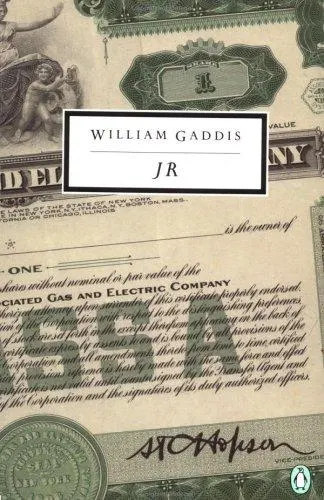
An eleven-year-old boy discovers that America’s financial machinery can be operated almost accidentally, largely through telephones and borrowed jargon. Like Billy Twillig, J R is a child moving through systems whose adults understand far less completely than they pretend.
Gaddis tells nearly the whole novel through unattributed dialogue: sales pitches, evasions, interruptions, pedagogical babble, and corporate euphemism accumulate into astonishing comic music. The pleasure resembles Ratner’s Star at its best—not simply difficulty, but the spectacle of specialized languages escaping their speakers and constructing a world of their own. Winner of the National Book Award and now regarded as a landmark of American postwar fiction, J R is the rare enormous experimental novel whose chaos becomes funnier, sadder, and more precise the longer one listens.

A secret scientific project gathers elite researchers to decipher what may be a message from space. That premise makes the kinship obvious; what makes Lem essential is his refusal to turn interpretation into a clean puzzle with a gratifying solution.
Instead, the novel anatomizes how scientists think: the metaphors they mistake for explanations, the disciplines that cannot communicate, and the human desires smuggled into supposedly objective reasoning. Lem’s wit is drier and more austere than DeLillo’s, but he shares DeLillo’s fascination with knowledge becoming theatrical at its limits. One of the great philosophical novels of science fiction, His Master’s Voice offers the unnerving possibility that intelligence is most visible not in what it deciphers, but in the elaborate forms of its failure.
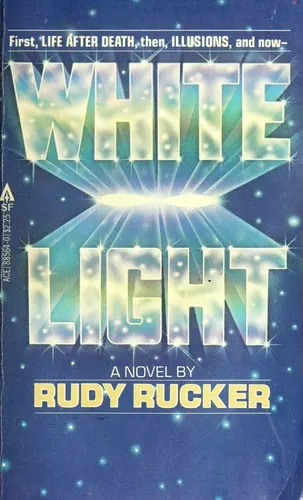
Felix Rayman, a dissatisfied mathematics professor, slips from academic frustration into a dreamlike encounter with infinity. Rucker—himself a mathematician—does not merely decorate the story with Cantor, continua, and transfinite numbers. He converts those ideas into places, creatures, jokes, and physical predicaments.
That makes White Light a particularly exhilarating companion to Ratner’s Star. Both novels treat mathematics as rigorous thought and as a portal through which ordinary reality becomes absurd; both understand that abstraction can produce slapstick as readily as sublimity. Rucker’s compact, unruly novel became a cult classic of mathematical science fiction because it possesses something exceedingly rare: genuine conceptual ambition without solemnity. It feels like contraband from a universe where a proof can become a landscape and infinity can misbehave.