
Books like Ubik
Some readers delight in fiction that pulls the floor from under them while cracking jokes about the cost of the flooring—readers drawn to metaphysical dread, shabby commerce, unstable identities, and realities that may already be expiring. These three novels reproduce that exhilarating unease without merely imitating Dick’s furniture.
If you liked Ubik, you’ll love these
Not lookalikes — kindred books. Each one shares something essential with Ubik, and we tell you exactly what.
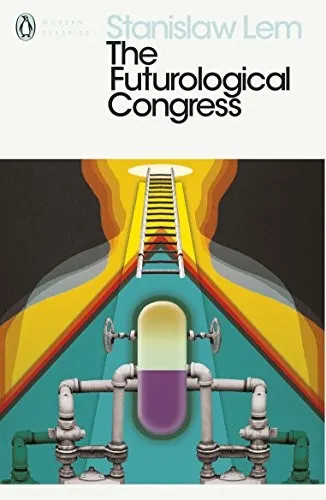
Ijon Tichy arrives at a lavish international conference while riots spread outside; then hallucination, propaganda, and chemical manipulation make every apparent awakening suspect. Lem keeps escalating the joke until perception itself feels like a product being aggressively marketed.
Like Ubik, this is both a reality puzzle and a savage comedy about people trying to conduct business as usual after “usual” has lost all meaning. Lem’s intellectual audacity never suppresses his slapstick energy: each revelation is hilarious, ingenious, and more alarming than the last. One of his most admired short novels, it offers the rare pleasure of being dazzled and existentially mugged at the same time.
Peter Sinclair, emotionally stranded after losing his job and his relationship, retreats to a friend’s cottage and begins writing an autobiography. But the life he records does not remain securely subordinate to the life he appears to be living.
Priest recreates Ubik’s peculiar intimacy: cosmic uncertainty arrives not through grand spectacle but through paperwork, memory, small contradictions, and a protagonist’s desperate wish to impose order. The prose is cool and exact, which makes every impossible transition more convincing. A defining work from one of Britain’s great specialists in unreliable realities, The Affirmation inspires the kind of devoted rereading Ubik does—because the second reading does not solve the first so much as beautifully destabilize it again.
A fugitive hiding on an apparently deserted island begins seeing elegantly dressed visitors who neither notice him nor behave quite like ordinary people. His fascination with one woman among them draws him toward the secret behind their uncanny repetitions.
This compact Argentine masterpiece shares Ubik’s obsession with machines, mortality, and the terrifying possibility that an artificial reality may be more durable than a human being. Yet its emotional register is entirely its own: lucid, romantic, and haunting rather than antic. Borges famously praised its plot as perfect, and its influence can be felt across speculative fiction and cinema. Barely longer than a novella, it leaves behind an idea so clean and potent that not reading it means missing one of the hidden foundations beneath modern reality-bending fiction.