
Books like Solaris
You responded to Solaris because its mystery resists conquest: the harder its characters seek knowledge, the more painfully they confront the limits of reason, language, and self-knowledge. These three novels preserve that intellectual vertigo while taking it in strikingly different directions.
If you liked Solaris, you’ll love these
Not lookalikes — kindred books. Each one shares something essential with Solaris, and we tell you exactly what.

Lem’s most natural successor to Solaris begins with a secret scientific project attempting to decode what may be an extraterrestrial neutrino signal. But the signal is less the novel’s subject than the human machinery brought to bear on it: brilliant minds, competing theories, military ambitions, vanity, and the desperate habit of mistaking interpretation for understanding.
Written as a mathematician’s retrospective account, the book has the severe pleasure of watching first-rate intelligence discover its own provincialism. It is one of Lem’s major philosophical novels, colder and more argumentative than Solaris but equally merciless about our desire to make the universe speak in human terms. To miss it is to miss Lem’s deepest return to the question Solaris leaves hauntingly open: what if the obstacle to contact is not distance, but the structure of the human mind?
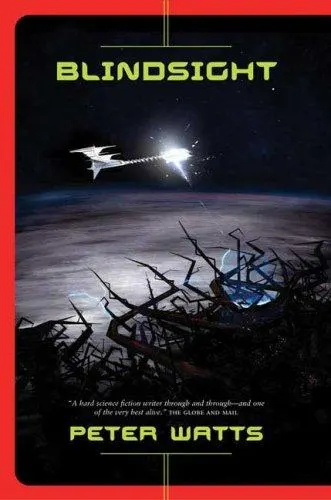
Blindsight takes the intellectual challenge of Solaris and turns it into a ruthless assault on consciousness itself. After an inexplicable visitation, a surgically altered narrator joins a crew of extreme specialists sent to investigate an alien presence at the edge of the solar system. Even among his shipmates, ordinary human psychology has become something strange and difficult to read.
Watts grounds his provocations in cognitive science, evolutionary biology, and unsettling thought experiments, yet the novel’s power comes from how personally it applies them. Its aliens are not disguised humans, and the encounter forces a terrifying question: is self-awareness an evolutionary triumph, or merely an expensive story intelligence tells itself? A Hugo nominee that has become a fiercely defended cult classic, Blindsight is one of the few modern contact novels bold enough to make Solaris feel not imitated, but answered.

On the Six-Thousand Ship, human and humanoid workers give brief statements about their jobs, their memories, and a collection of mysterious objects brought aboard from a planet. Their testimonies gradually produce an eerie collective portrait: sensuous, bureaucratic, funny, and increasingly difficult to divide into human feeling and programmed response.
Where Solaris surrounds an unknowable intelligence with scientific reports, Ravn builds her novel from workplace depositions—small voices circling experiences that official language cannot contain. The objects exert the same kind of pressure as Lem’s ocean: they expose private longing while refusing stable explanation. Shortlisted for the International Booker Prize, this slender Danish novel has earned an ardent readership because it accomplishes in barely more than a hundred pages what much longer science fiction cannot: it makes personhood itself feel alien, fragile, and newly precious.