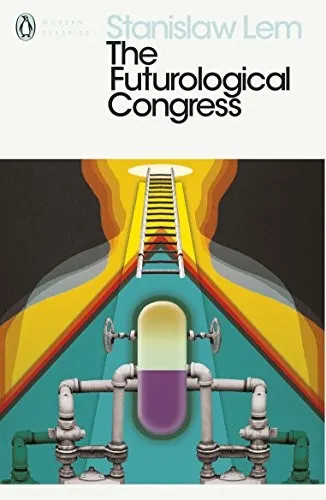
Books like The Futurological Congress
If every sensation can be manufactured, what could possibly prove that you are awake, sane, or free? These three novels turn that uncertainty into wildly different kinds of intellectual comedy.
If you liked The Futurological Congress, you’ll love these
Not lookalikes — kindred books. Each one shares something essential with The Futurological Congress, and we tell you exactly what.

Reality begins to malfunction around a group of psychic-security specialists: time slips, objects regress, and an omnipresent commercial product called Ubik offers help in increasingly absurd forms. Like Lem, Dick makes ontological panic inseparable from satire—the same world that may be dissolving still insists on advertising to you.
Widely regarded as one of Dick’s defining novels, Ubik has his rarest combination of virtues: pulp velocity, metaphysical terror, deadpan jokes, and genuine emotional stakes. If The Futurological Congress delighted you by repeatedly pulling the floor out from under Ijon Tichy, Ubik builds an entire funhouse from trapdoors.

An unnamed narrator enters an Irish police station and discovers that ordinary logic has been replaced by an elaborate, serenely administered nonsense involving bicycles, measurements, mysterious machinery, and theories no sane person could invent—or refute. Footnotes on the preposterous philosopher de Selby create a second comic universe beside the first.
This is the recommendation for readers who loved Lem’s language as much as his ideas. O’Brien turns pedantry into surrealism and bureaucratic explanation into a threat; every lucid sentence makes the world less comprehensible. Neglected when written and later embraced as a cult masterpiece, The Third Policeman is one of the indispensable comic novels of metaphysical disorientation.

In post-Soviet Moscow, Babylen Tatarsky finds work manufacturing advertisements and political images for a culture rapidly exchanging one compulsory reality for another. Drugs, television, consumer mythology, and ancient symbolism begin to overlap until it becomes difficult to say whether commerce merely represents the world or secretly produces it.
Pelevin, one of the most distinctive voices in post-Soviet fiction, shares Lem’s gift for making philosophy arrive as a savage punchline. Homo Zapiens is less interested in predicting technology than in exposing the machinery that manufactures desire and belief. Its brand names, slogans, hallucinations, and obscene jokes accumulate into a devastating question: if public reality is only another product, who wrote the campaign?