Author
Books like Carlo Emilio Gadda
5 books we recommend to Carlo Emilio Gadda readers, drawn from That Awful Mess on Via Merulana and The Experience of Pain — each with the reason why.
If you loved That Awful Mess on Via Merulana

Gaddis creates social chaos almost entirely out of voices: interrupted telephone calls, corporate euphemisms, schoolroom chatter, sales pitches, evasions, and misunderstandings. At its center is an eleven-year-old boy who begins assembling a financial empire through the communications systems around him, although no one—including the reader—can ever obtain a clean view of the whole machine.
Like Gadda, Gaddis makes reading an act of detection. Speakers are often unidentified, causes disappear into networks, and apparent nonsense gradually reveals the logic of an entire society. The comedy is volcanic, yet underneath it lies fury at the way institutions turn human beings into noise. Winner of the National Book Award and sustained by unusually devoted readers, J R is one of the great polyphonic American novels: difficult for precisely the reason it is indispensable—it makes systemic confusion audible.
Saer takes the intellectual unease of Gadda’s murder inquiry and cools it into a hypnotic, exacting trance. A series of killings in Paris draws a police investigator into a world where evidence, memory, and identity refuse to stay fixed; elsewhere, friends gather beside Argentina’s Paraná River and argue over stories and interpretation.
Where Gadda crowds the page with dialect and grotesque incident, Saer circles physical details in long, lucid sentences until certainty begins to dissolve. Both writers understand that investigation is never only about discovering a culprit: it tests whether events possess a stable meaning at all. Saer is revered as one of Argentina’s major modern novelists, and this short, concentrated book shows why. It delivers the satisfactions of a crime novel while quietly dismantling the assumptions that make those satisfactions possible.
If you loved The Experience of Pain
Donoso’s masterpiece begins in a decaying religious house inhabited by old women, servants, and the elusive Mudito, then steadily makes every stable distinction—master and dependent, body and disguise, mansion and prison—feel unreliable. Its prose has Gadda’s gift for turning physical detail into grotesque metaphysics: deformity, gossip, superstition, and class resentment breed inside one another.
A landmark of the Latin American Boom, it is stranger and more claustrophobic than most of its celebrated contemporaries. Like Gadda, Donoso makes horror inseparable from farce and treats a grand household as both social anatomy and wounded mind. Readers who love the way The Experience of Pain becomes more emotionally devastating as it grows more baroque should not miss this feverish, inexhaustible novel.

A telegram tells Franz-Josef Murau that his parents and brother have died, forcing him to reckon with Wolfsegg, the Austrian family estate he has fled. What follows is a tremendous sustained act of accusation: against family pieties, inherited property, provincial self-satisfaction, and the lies by which a nation launders its past.
The kinship with Gadda lies in rage as an instrument of precision. Bernhard’s recursive sentences keep worrying an insult or memory until hatred reveals attachment, and attachment reveals grief. Extinction is among his culminating achievements, both savagely funny and unexpectedly vulnerable. If Gonzalo’s hostility toward home and mother felt less like misanthropy than love made unlivable, Murau’s monologue will feel electrifyingly familiar.
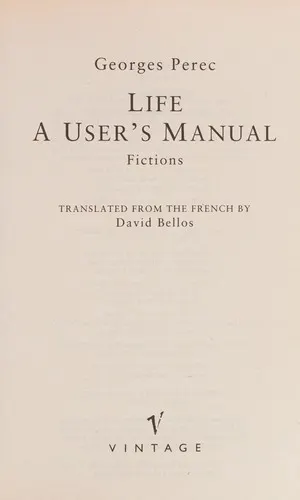
Perec removes the façade from a Paris apartment building and enters its rooms one by one, assembling lives from furniture, collections, unfinished projects, eccentric rules, and apparently trivial objects. The result is an encyclopedic fiction in which inventory becomes storytelling and digression becomes architecture.
This is the recommendation for the reader who loved Gadda’s conviction that no object is ever merely an object: each thing drags behind it a chain of owners, desires, technical vocabularies, failures, and jokes. Winner of the Prix Médicis and now a touchstone of Oulipian fiction, Perec’s novel inspires unusually devoted rereading because its dazzling machinery conceals a profound tenderness for thwarted designs and vanished people. It offers the rare pleasure of abundance without weightlessness: beneath every ingenious pattern waits the ache of what cannot be restored.