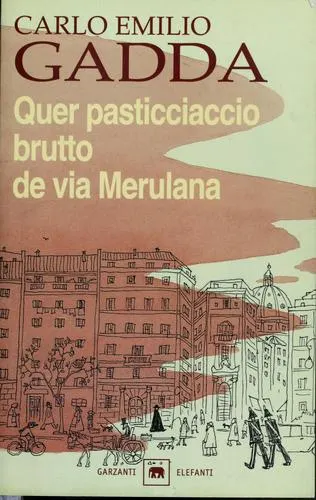
Books like That Awful Mess on Via Merulana
A city babbles in incompatible voices; clues multiply instead of clarifying; farce keeps opening onto grief, corruption, and the suspicion that reality itself is badly governed. These novels preserve that exhilarating disorder without merely imitating Gadda’s machinery.
If you liked That Awful Mess on Via Merulana, you’ll love these
Not lookalikes — kindred books. Each one shares something essential with That Awful Mess on Via Merulana, and we tell you exactly what.
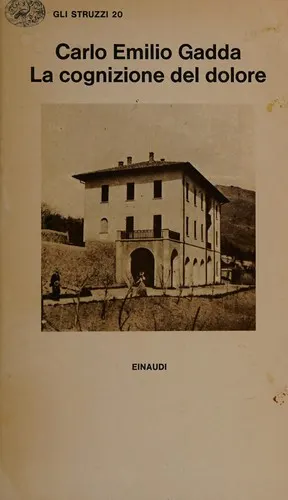
This is not simply another helping of Gadda. It is the novel in which his linguistic extravagance becomes most painfully intimate. In the imaginary country of Maradagàl, an embittered intellectual retreats with his mother to a decaying villa, while servants, neighbors, officials, and parasites invade every boundary he tries to maintain.
The same macaronic comedy found on Via Merulana is here compressed around filial guilt, thwarted tenderness, and self-disgust. Bureaucratic jargon and dialect remain uproarious, but each verbal deformation seems to expose an emotional wound. Widely regarded as one of Gadda’s masterpieces, this unfinished novel reveals the private anguish powering his public satire; anyone who knows only the detective novel has seen the fireworks but not yet the furnace.
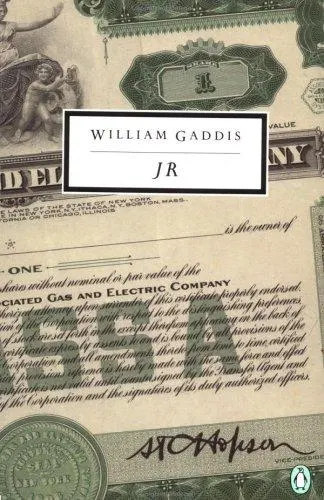
Gaddis creates social chaos almost entirely out of voices: interrupted telephone calls, corporate euphemisms, schoolroom chatter, sales pitches, evasions, and misunderstandings. At its center is an eleven-year-old boy who begins assembling a financial empire through the communications systems around him, although no one—including the reader—can ever obtain a clean view of the whole machine.
Like Gadda, Gaddis makes reading an act of detection. Speakers are often unidentified, causes disappear into networks, and apparent nonsense gradually reveals the logic of an entire society. The comedy is volcanic, yet underneath it lies fury at the way institutions turn human beings into noise. Winner of the National Book Award and sustained by unusually devoted readers, J R is one of the great polyphonic American novels: difficult for precisely the reason it is indispensable—it makes systemic confusion audible.
Saer takes the intellectual unease of Gadda’s murder inquiry and cools it into a hypnotic, exacting trance. A series of killings in Paris draws a police investigator into a world where evidence, memory, and identity refuse to stay fixed; elsewhere, friends gather beside Argentina’s Paraná River and argue over stories and interpretation.
Where Gadda crowds the page with dialect and grotesque incident, Saer circles physical details in long, lucid sentences until certainty begins to dissolve. Both writers understand that investigation is never only about discovering a culprit: it tests whether events possess a stable meaning at all. Saer is revered as one of Argentina’s major modern novelists, and this short, concentrated book shows why. It delivers the satisfactions of a crime novel while quietly dismantling the assumptions that make those satisfactions possible.