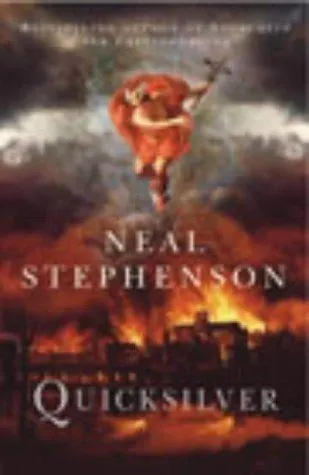
Books like Quicksilver
After that exhilarating collision of science, money, politics, low comedy, and world-changing ideas, only another novel of vast intellectual appetite will do. These three make history feel unstable, interconnected, and dangerously alive.
If you liked Quicksilver, you’ll love these
Not lookalikes — kindred books. Each one shares something essential with Quicksilver, and we tell you exactly what.
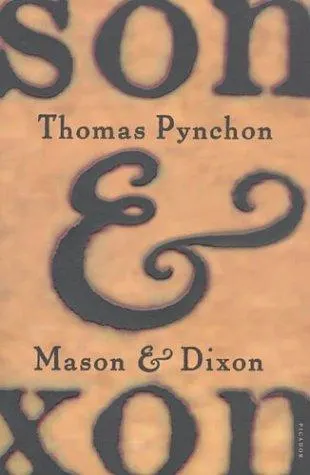
Pynchon turns the partnership of astronomer Charles Mason and surveyor Jeremiah Dixon into a funny, melancholy epic about how knowledge becomes power. Instruments, measurements, colonial commerce, and Enlightenment argument matter here—but so do tavern stories, mechanical marvels, bad jokes, and the friendship between two gloriously imperfect men.
Its antiquated, elastic prose demands attention, then becomes intoxicating: history seems to be invented aloud, with fact continually shading into folklore. Often regarded as one of Pynchon’s masterpieces, it offers the rare combination Quicksilver achieves so well—formidable learning transformed into exuberant entertainment.
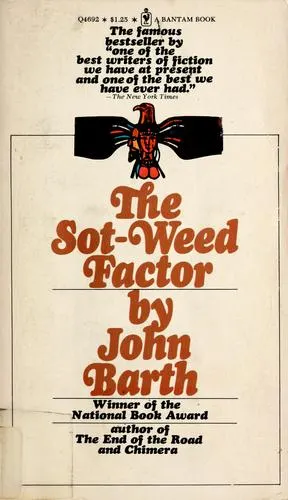
For the bawdy, swashbuckling side of Quicksilver, read Barth’s enormous comic picaresque. Its hero, Ebenezer Cooke, is an extravagantly innocent poet dispatched to colonial Maryland, where nearly everyone proves to be a fraud, opportunist, storyteller, or some inventive combination of the three.
Barth piles up disguises, reversals, forged histories, obscene mishaps, and rhetorical fireworks until the novel becomes a joyful assault on the idea that history is orderly or trustworthy. A landmark of American postmodern fiction, it has inspired unusually devoted readers because its difficulty is inseparable from its fun. Few novels are this learned while behaving this badly.

Tokarczuk supplies the scale: hundreds of characters, competing faiths, trade routes, medicine, printing, court politics, and private desires all moving through eighteenth-century Europe. At the center is Jacob Frank, a charismatic religious figure whose growing following unsettles the boundaries among Judaism, Christianity, mysticism, and political calculation.
What connects it most deeply to Quicksilver is its fascination with ideas as material forces. Beliefs reorganize families; information travels through fragile networks; institutions struggle to control changes they only partly understand. Tokarczuk, a Nobel laureate, makes this immense architecture intimate through sharply observed lives and shifting perspectives. The result is not merely a historical panorama but a world one gradually learns to inhabit—and then resents having to leave.