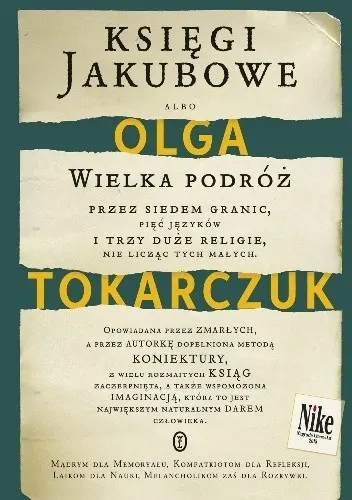
Books like The Books of Jacob
…because Tokarczuk’s triumph is not merely reconstructing a vanished world, but making history feel crowded with incompatible truths, unruly bodies, forged documents, sincere visions, and dangerous ideas. These three novels create that same exhilarating sense that the past cannot be mastered—only entered.
If you liked The Books of Jacob, you’ll love these
Not lookalikes — kindred books. Each one shares something essential with The Books of Jacob, and we tell you exactly what.
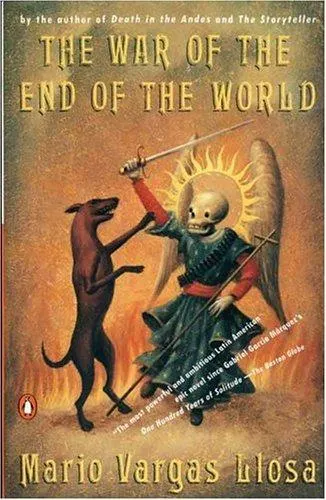
A wandering ascetic called the Counselor gathers followers in the Brazilian backlands, and a settlement begins to form around his apocalyptic teaching. Yet Vargas Llosa refuses to reduce the movement to either holy revelation or collective delusion. As in The Books of Jacob, belief becomes a material force: it feeds people, reorganizes loyalties, attracts opportunists, and terrifies institutions that cannot understand it.
The novel keeps changing vantage point—among zealots, soldiers, politicians, journalists, and outcasts—until certainty itself becomes impossible. Vargas Llosa, later a Nobel laureate, considered this vast, ferocious book one of his most ambitious achievements, and it remains among his masterpieces. Few novels show so powerfully how official history is manufactured from encounters in which everyone misreads everyone else.
Pavić turns an obscure religious controversy into a beguiling counterfeit reference book. Christian, Islamic, and Jewish sources offer contradictory accounts of the Khazars’ conversion, while scholars, dream hunters, princesses, demons, and poisoned texts migrate between entries. You may read it alphabetically, follow its cross-references, or invent your own route through it.
What will delight a Tokarczuk reader is the way scholarship becomes fiction without losing its intellectual charge. Every document looks authoritative until another document quietly sabotages it; translation preserves knowledge while also mutating it. First published in 1984, the novel became an international cult classic because its formal ingenuity is inseparable from its central seduction: the suspicion that truth survives only as a quarrel among stories. It is shorter than The Books of Jacob, but scarcely less labyrinthine.
Charles Mason and Jeremiah Dixon—astronomer and surveyor—set out into an eighteenth century alive with scientific rivalry, imperial commerce, tavern gossip, mechanical marvels, songs, ghosts, and talking creatures. Their famous line begins as a technical assignment, but Pynchon makes measurement itself morally and metaphysically strange: what happens when human beings impose a clean abstraction upon a world that refuses to stay divided?
Like Tokarczuk, Pynchon combines immense research with irreverence, tenderness, and an appetite for everything history normally discards. Learned arguments sit beside low comedy; invented sources mingle with documented lives; minor figures repeatedly seize the narrative from supposedly important men. Widely regarded by Pynchon’s most devoted readers as one of his finest novels, Mason & Dixon offers the rare pleasure of a maximalist historical book whose abundance is its argument: no border, archive, or official story can contain reality.