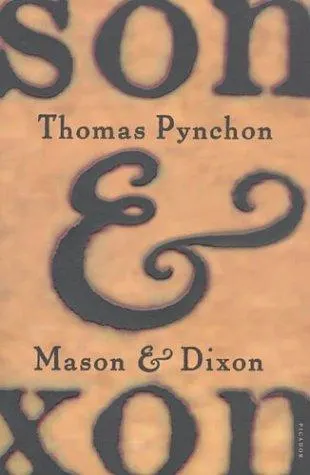
Books like Mason & Dixon
Outside, the children’s snowball war subsides; by the fire, the disreputable Reverend Cherrycoke earns his welcome by beginning a story.
If you liked Mason & Dixon, you’ll love these
Not lookalikes — kindred books. Each one shares something essential with Mason & Dixon, and we tell you exactly what.
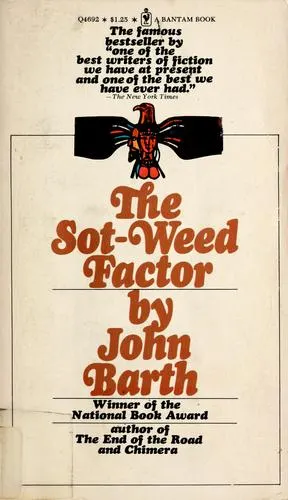
The closest precursor to Mason & Dixon’s verbal carnival, Barth’s landmark of American postmodernism turns colonial history into an enormous picaresque of forged documents, literary imposture, sexual farce, and epistemological mischief. Its mock-eighteenth-century prose is not decorative antiquing: every elaborate sentence asks who controls the story, whether innocence is wisdom or folly, and how history hardens out of competing lies.
Barth has Pynchon’s gift for making high intellectual comedy feel gloriously low. Learned allusions jostle with slapstick; philosophical disputes end in embarrassment; digressions proliferate until they become the real route through the book. Yet beneath the virtuosity lies a serious fascination with compromised ideals. Mason & Dixon readers will recognize that peculiar pleasure of laughing through hundreds of pages only to realize the joke has acquired moral weight. This is one of the books that made Pynchon’s kind of historical extravagance possible.
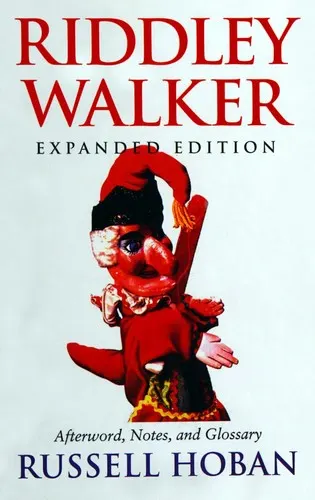
Read the first page aloud. Hoban’s shattered English initially looks forbidding, then begins to disclose its own wit, rhythm, and precision; before long, ordinary English can seem comparatively lifeless. Like Pynchon’s eighteenth-century idiom, Riddley’s voice is a complete theory of history: words preserve garbled memories, institutional power, old technologies, and dangers their speakers no longer understand.
This cult classic inhabits a broken future in which myth and science continually change places. Its affinity with Mason & Dixon lies less in encyclopedic scale than in its conviction that maps, stories, measurements, and performances are never neutral. Hoban also shares Pynchon’s rare tonal balance: bawdy comedy and linguistic play coexist with loneliness, violence, and an almost unbearable yearning for lost knowledge. Few novels so thoroughly rewire a reader’s ear—or inspire such devotion in those who surrender to them.
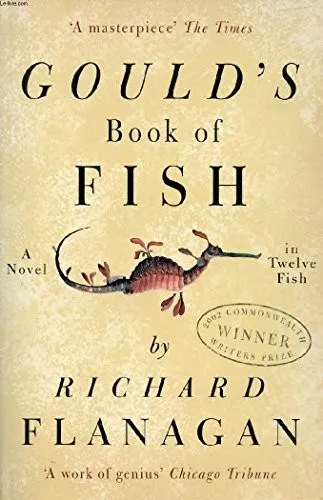
Flanagan offers history as a gorgeous, fraudulent artifact: a manuscript crowded with fish, convicts, officials, fantasies, erasures, and mutually incompatible versions of reality. The narrative keeps transforming under the reader’s hands, but its formal exuberance never insulates it from colonial brutality. As in Mason & Dixon, invention becomes a way to recover what official records suppress rather than an excuse to evade fact.
Winner of the Commonwealth Writers’ Prize, the novel has the reckless confidence of a tall tale and the grief of a witness statement. Flanagan’s sentences can be grotesque, ecstatic, tender, or furiously comic, sometimes within a single paragraph. What begins as an extravagant exercise in unreliable narration becomes a passionate argument about who gets classified, named, painted, imprisoned, and remembered. A reader drawn to Pynchon’s mingling of wonder and historical guilt should not miss it.