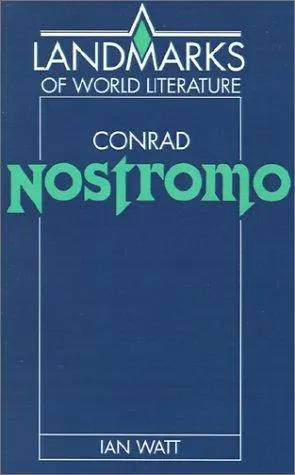
Books like Nostromo
Beyond the dark gulf and pale offshore rocks, Sulaco lies shut behind its mountains, less a city than a world awaiting its fate. These novels share Conrad’s panoramic intelligence: they show private motives hardening into public history, while ideals, money, and myth conceal one another.
If you liked Nostromo, you’ll love these
Not lookalikes — kindred books. Each one shares something essential with Nostromo, and we tell you exactly what.
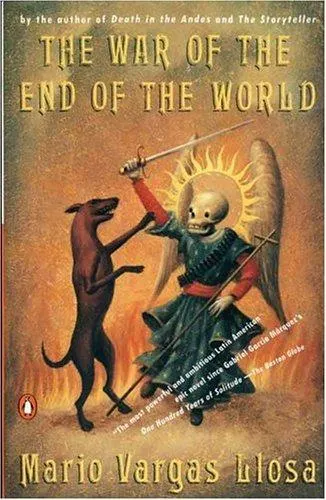
A prophetic preacher gathers Brazil’s dispossessed at Canudos; the young republic, unable to comprehend the settlement, imagines a vast conspiracy. From this collision Vargas Llosa builds one of the great political novels of the late twentieth century, and arguably his masterpiece.
Like Nostromo, it refuses to grant any faction a monopoly on truth. Revolutionaries, landowners, journalists, soldiers, and fanatics each see clearly enough to act—and too narrowly to understand what their actions create. Its many viewpoints generate the same terrible Conrad-like irony: history emerges not from a master plan but from incompatible convictions, material interests, vanity, and rumor. The scale is immense, yet even minor figures possess unforgettable moral weight. If you loved watching Costaguana become both a place and a collective delusion, Canudos is indispensable.
Artemio Cruz opens his eyes in a sickroom, surrounded by relatives and associates already maneuvering around his power. Fuentes then breaks consciousness into first, second, and third person, making a single man’s identity feel like evidence under interrogation.
This landmark of the Latin American Boom has Nostromo’s fascination with the point where heroic self-conceptions become inseparable from wealth and control. Fuentes is especially acute about retrospective mythmaking: Artemio’s memories do not simply disclose a life but compete to define it, much as Conrad’s shifting chronology turns Nostromo from man into legend and then questions the legend. The prose can be sensuous, accusatory, and exhilaratingly abrupt. Few novels expose more forcefully how a nation’s betrayed ideals may survive inside the very people who betrayed them.
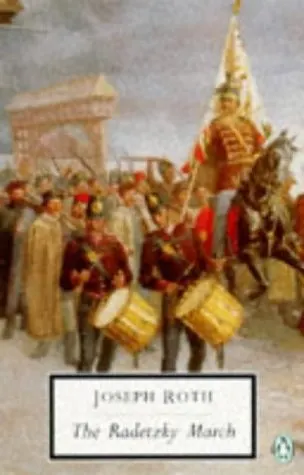
At Solferino, an infantry officer saves the young emperor and is rewarded with a title; almost at once, the official account begins falsifying what happened. From that superb opening, Roth follows three generations whose private lives become entangled with the rituals of the Austro-Hungarian Empire.
Roth’s masterpiece offers the same pleasure as Conrad’s quieter passages: immaculate narrative control, devastating irony, and sympathy untouched by sentimentality. Uniforms, ceremonies, portraits, debts, and military postings form an entire political theology, even as the society that believes in them begins to hollow out. Where Nostromo gives silver an almost supernatural authority, Roth lets imperial symbols govern people who half know they are obsolete. The novel is more restrained than Conrad’s, but its restraint makes every humiliation and flicker of loyalty cut deeper. To miss it is to miss one of European fiction’s most beautiful accounts of people living inside a doomed idea.