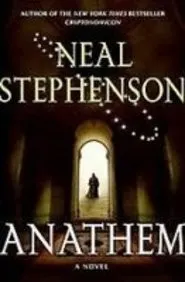
Books like Anathem
Reading Anathem feels like being apprenticed to an alien civilization: first you learn its language and disciplines, then its arguments become urgent, and finally abstractions you have been patiently mastering swing into place as the machinery of an immense adventure.
If you liked Anathem, you’ll love these
Not lookalikes — kindred books. Each one shares something essential with Anathem, and we tell you exactly what.

Palmer offers the same exhilarating bargain Stephenson does: tolerate initial disorientation and a whole political-philosophical world will gradually become legible. Its twenty-fifth century has discarded nations for voluntary global affiliations, while its narrator—learned, theatrical, compromised—addresses the reader as though writing an Enlightenment history.
What makes it an essential match is not the future-world density but the way ideas acquire force. Debates about theology, governance, gender, punishment, and historical progress are also struggles over who gets to shape reality. A Hugo finalist and the opening of the fiercely admired Terra Ignota quartet, it inspires the kind of obsessive rereading Anathem does: once Palmer’s design becomes visible, not continuing feels almost impossible.
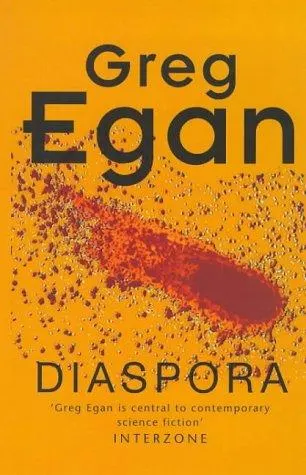
If Anathem’s most intoxicating passages were those where mathematics, cosmology, and metaphysics ceased to be decoration and became the adventure itself, read Diaspora. It begins with the creation of Yatima, a digital person born inside a virtual polis, and proceeds from first principles: What counts as a self? What does embodiment mean? How much of the universe can intelligence truly comprehend?
Egan is among hard science fiction’s most uncompromising and revered writers, and Diaspora is a touchstone of the field because its conceptual audacity is matched by genuine cosmic awe. It asks work of the reader, but repays that work with vistas few novels even attempt. Anathem makes intellectual discovery thrilling; Diaspora makes it sublime.

Hesse’s final novel imagines Castalia, an elite community devoted to scholarship, contemplation, and the Glass Bead Game—an elusive synthesis of music, mathematics, philosophy, and cultural memory. Its deepest kinship with Anathem lies in its scrutiny of the disciplined life: the beauty of withdrawing from ordinary society to preserve thought, and the danger that such purity may become sterile or evasive.
The novel follows Joseph Knecht’s formation within this order with patient, cumulative power. Rather than merely praising intellectual devotion, Hesse tests its obligations to history and to people outside the cloister. Written by a future Nobel laureate and widely regarded as his culminating masterpiece, it is one of the rare novels that can make a life of thought feel both sacred and morally insufficient.