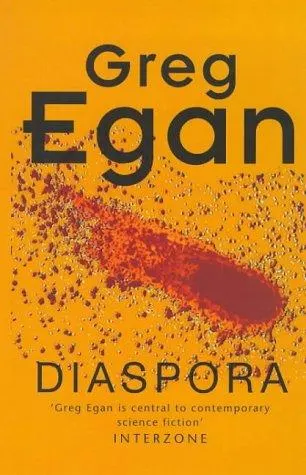
Books like Diaspora
Vertigo, exhilaration, and a strange tenderness before realities too large for human intuition bind these three novels together. Each treats ideas not as decoration but as engines of wonder.
If you liked Diaspora, you’ll love these
Not lookalikes — kindred books. Each one shares something essential with Diaspora, and we tell you exactly what.
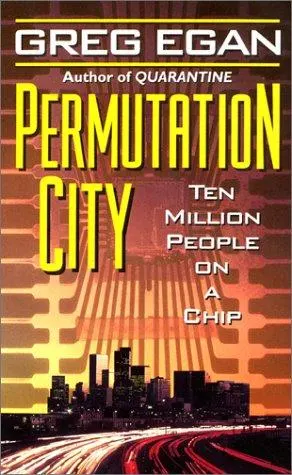
If Diaspora made consciousness feel simultaneously mathematical and miraculous, this is its indispensable companion. Paul Durham experiments with software Copies of human minds, while programmer Maria Deluca builds an artificial ecosystem governed by its own physics. From that opening, Egan presses relentlessly on a destabilizing question: if experience can be computed, what makes any world—or self—real?
Winner of the John W. Campbell Memorial Award, Permutation City is one of the foundational novels of computational existence. It is narrower than Diaspora in scale but even more concentrated in philosophical force: a thought experiment made emotionally urgent. Anyone captivated by the polis citizens and invented cosmologies of Diaspora should see the conceptual furnace from which they emerged.
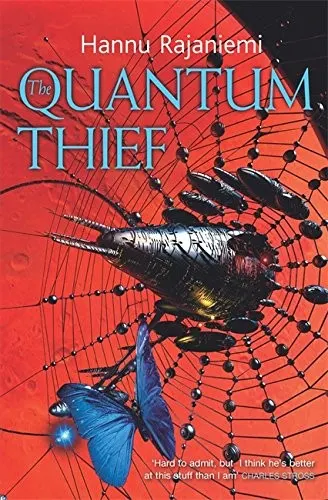
Rajaniemi offers the pleasure of being dropped into a civilization whose assumptions you must reconstruct for yourself. A legendary thief begins in a prison built from iterated game theory before being rescued into a Solar System of engineered minds, negotiated memories, cryptographic identities, and societies with radically different definitions of privacy and personhood.
Like Egan, Rajaniemi refuses to translate every idea into familiar terms. The density is part of the seduction: each unfamiliar word implies an entire technology or social compact, and comprehension arrives through accumulation rather than exposition. Yet beneath the glittering machinery lies an intimate story about memory, obligation, and whether identity survives revision. Few posthuman novels make strenuous reading feel this playful—or reward attention so lavishly.
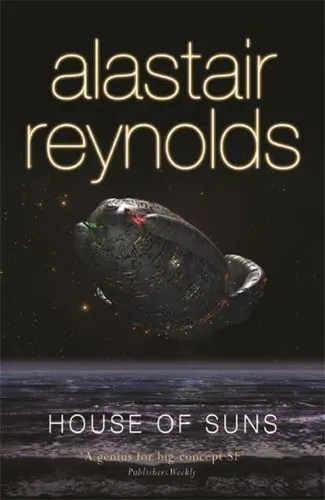
For the deep-time awe of Diaspora, read the Reynolds novel many of his admirers regard as his finest standalone. Abigail Gentian has created a thousand near-clones of herself, sending them across the galaxy to gather experience; every circuit of the Milky Way, the scattered “shatterlings” reunite and exchange memories. Campion and Purslane are two such travelers, arriving late to a gathering that has gone catastrophically wrong.
Reynolds makes millions of years feel lived rather than merely stated. Civilizations flower and vanish between meetings, while relationships persist in altered, sometimes painful forms. The book has the propulsion of a cosmic mystery, but its lasting power comes from the tension between astronomical duration and stubborn attachment. It supplies the grandeur Diaspora readers crave without sacrificing warmth—and its final reaches contain some of modern space opera’s most haunting images.