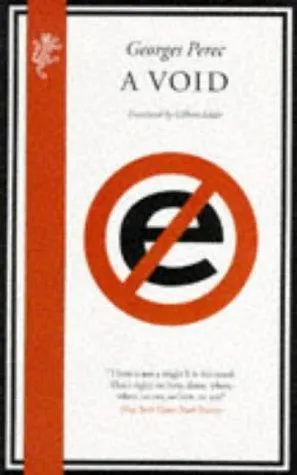
Books like A Void
Reading A Void is like watching language perform an impossible escape act: the joke keeps tightening into menace, every sentence flaunts its ingenuity, and the missing letter gradually becomes a haunting presence.
If you liked A Void, you’ll love these
Not lookalikes — kindred books. Each one shares something essential with A Void, and we tell you exactly what.
Perec’s acknowledged masterpiece turns a Paris apartment block into an immense narrative puzzle. Moving from room to room according to an underlying knight’s-tour pattern, it inventories paintings, schemes, deaths, collections, disappointments and unfinished lives with inexhaustible comic precision.
As in A Void, the constraints are not decorative tricks: they create a world obsessed with what cannot be completed or recovered. Winner of the Prix Médicis and a cornerstone of Oulipian fiction, it offers the rare pleasure of discovering that Perec could build something even more intricate, humane and moving than his lipogram.
Published as loose, unbound sections in a box, The Unfortunates asks you to shuffle most of its chapters before reading. What initially seems like literary gamesmanship becomes the exact form needed for a mind overtaken by grief: memory refuses chronology, arriving instead through accidents, repetitions and painful gaps.
Johnson’s cult novel shares A Void’s deepest achievement—the transformation of absence into structure—but its voice is rawer and more intimate. Few experimental novels make their physical design feel so emotionally inevitable; leaving it unread means missing one of the clearest proofs that formal radicalism can intensify, rather than chill, human feeling.
Abish begins with a chapter using only words that start with A, then admits B-words in the next, C-words after that, and so on; halfway through, the alphabet begins withdrawing again. Out of this absurdly severe rule he produces pursuit, desire, danger and a wonderfully unstable Africa assembled from the vocabulary available at each moment.
The fun lies in feeling the prose gain and lose powers before your eyes. Yet, like A Void, the novel also makes linguistic control suspicious: what looks like abundance is shaped by arbitrary exclusions, and the world on the page keeps revealing the limits of the language describing it. A landmark of American experimental fiction, it is audacious, compact and unlike almost anything else.