
Books like Alphabetical Africa
Walter Abish’s Alphabetical Africa and Georges Perec’s A Void turn the alphabet into a mischievous coauthor, letting linguistic permission dictate fictional possibility.
If you liked Alphabetical Africa, you’ll love these
Not lookalikes — kindred books. Each one shares something essential with Alphabetical Africa, and we tell you exactly what.
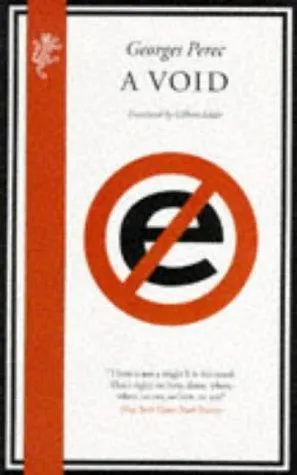
Perec removes the letter “e” entirely; Gilbert Adair’s prize-winning English translation miraculously preserves the omission. As Anton Vowl senses that something is missing, the reader begins inspecting every sentence, simultaneously following the mystery and watching language contort around its forbidden center.
Like Abish, Perec makes constraint generative rather than decorative: odd synonyms, comic excesses and mounting paranoia all arise from the rule. Yet the missing letter also gives absence emotional weight. An Oulipo landmark, A Void is the rare formal stunt that becomes stranger and more affecting once you know exactly how it works.
Between eliminates every form of the verb “to be.” Its unnamed simultaneous interpreter moves through airports, hotels and conferences while announcements, advertisements and several languages flow through her consciousness. Without “is” or “am,” neither place nor identity can settle into certainty.
Where Abish creates a shifting world by regulating vocabulary, Brooke-Rose destabilizes reality through grammar itself. Her sentences hover, splice and accelerate; the constraint becomes the sensation of living perpetually in transit. Brooke-Rose remains a revered writers’ writer, and Between is among her sharpest achievements: less a puzzle to solve than a linguistic condition unavailable anywhere else.
A peculiar inheritance sends Mathews’s narrator in pursuit of answers to three riddles, and ordinary inquiry soon blossoms into fabricated scholarship, arcane ceremonies, emblems, puns and competing systems of interpretation. Every discovery seems to generate a fresh rule—and every rule another world.
Readers of Abish will recognize the comedy of arbitrary order masquerading as destiny. Mathews does not use one conspicuous constraint; instead, he shows minds compulsively manufacturing structures, then becoming trapped inside them. Written before he became Oulipo’s first American member, this cult novel already possesses his distinctive mixture of elegance, intellectual mischief and deadpan absurdity. Its labyrinth feels inexhaustible rather than merely obscure.