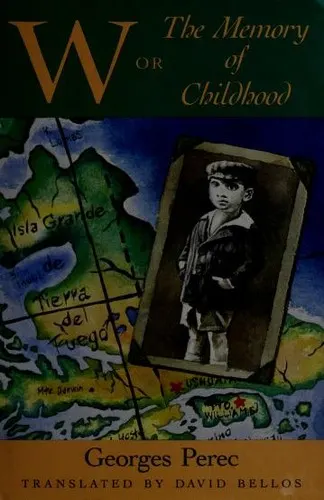
Books like W, or the Memory of Childhood
A childhood begins as a blank: no memories, only the stubborn need to account for their absence. These three novels likewise make form itself carry what ordinary recollection cannot.
If you liked W, or the Memory of Childhood, you’ll love these
Not lookalikes — kindred books. Each one shares something essential with W, or the Memory of Childhood, and we tell you exactly what.
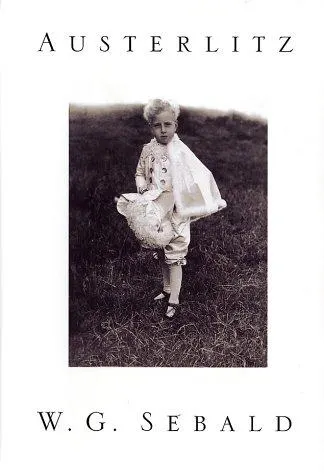
An unnamed narrator repeatedly encounters Jacques Austerlitz, an architectural historian whose talks about stations, fortresses and waiting rooms gradually acquire the pressure of something unspoken. Sebald’s immense, winding sentences move like recollection itself: digressive, delayed and suddenly pierced by recognition.
A lover of W will recognize the distrust of straightforward testimony. Photographs appear to offer evidence, yet deepen the mystery; buildings preserve history while concealing it. Widely regarded as Sebald’s masterpiece, Austerlitz achieves that rare fusion of documentary exactness and haunted invention in which every formal hesitation feels ethically necessary.
Momik, the child of Holocaust survivors, hears fragments of adult speech—coded phrases, abruptly silenced stories—and tries to turn them into an intelligible mythology. His idea of the “Nazi Beast” is at once ingenious and heartbreaking: a child’s attempt to give shape to the terror governing his household.
Grossman shares Perec’s conviction that inherited catastrophe cannot be approached through conventional realism alone. The novel keeps reinventing its imaginative terms, making fantasy not an escape from history but a perilous route toward it. A landmark of modern Israeli fiction, See Under: Love is audacious, strange and emotionally overwhelming—the kind of novel that permanently enlarges one’s sense of what fiction can attempt.
A sportswriter arrives in an unfamiliar city and finds that its streets involuntarily summon memories of his dead friend Tony. Johnson printed the novel in twenty-seven separately bound sections inside a box: only the first and last are fixed, while the middle sections may be read in any order.
That device is not a clever accessory. It makes the reader experience memory as Perec does: discontinuously, repetitively, with trivial details beside unbearable ones and no retrospective order capable of repairing the loss. Long cherished as a cult masterpiece of British experimental fiction, The Unfortunates proves that radical form can produce extraordinary intimacy. Few novels make remembering feel so physical—or grief so alive.