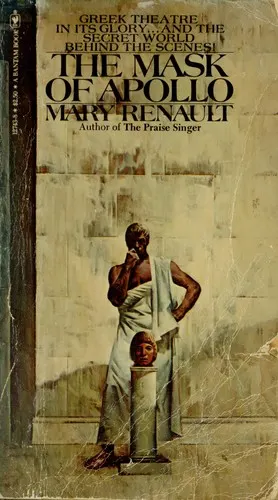
Books like The Mask of Apollo
In The Mask of Apollo, acting is not an escape from public life: the stage tells truths that philosophers and rulers cannot make the world obey. These novels pursue its three great concerns—artistic vocation, political idealism, and the dignity of seeing history clearly.
If you liked The Mask of Apollo, you’ll love these
Not lookalikes — kindred books. Each one shares something essential with The Mask of Apollo, and we tell you exactly what.
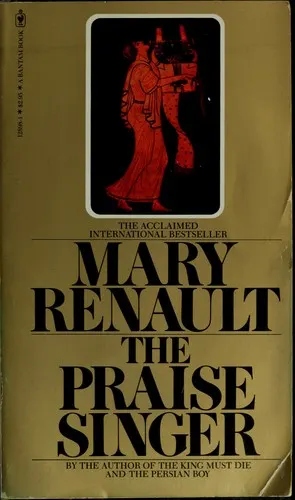
Renault’s portrait of the poet Simonides is the closest companion to The Mask of Apollo—not simply because it returns to Greece, but because it again makes an artist’s craft the measure of a civilization. Simonides must earn his living among patrons and rulers while preserving the part of himself from which real poetry comes. Performance is skilled labor, a source of pride, and a dangerous intimacy with power.
The older Simonides narrates with Nikeratos’s mixture of shrewdness, modesty, and retrospective sorrow. Renault is especially good on how artists observe: the revealing gesture, the mood of a crowd, the instant when ceremony becomes truth. Often overshadowed by her Alexander novels, The Praise Singer deserves to be read as her other great testament to Apollo’s servants.
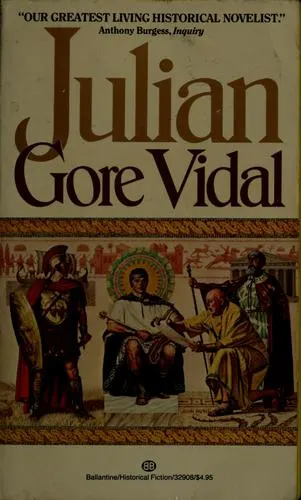
The philosophical dream that draws Plato and Dion toward Syracuse finds a darker echo in Vidal’s Emperor Julian, who attempts to turn an intellectual and religious vision into imperial policy. Vidal understands, as Renault does, that ideas change when they acquire courtiers, budgets, enemies, and an army.
Julian’s memoir is framed and interrupted by two former teachers who dispute his judgments, giving the novel the delicious feeling of a performance annotated from the wings. The result is witty, skeptical, and unexpectedly moving: admiration for a cultivated idealist never prevents scrutiny of his vanity or blindness. Widely regarded as one of Vidal’s finest historical novels, Julian offers the same rare pleasure as Renault—watching a vanished moral world become coherent from within, then collide with political reality.
Prince Fabrizio of Salina, watching Garibaldi’s revolution transform Sicily, possesses something Nikeratos gradually acquires: the painful ability to recognize history’s direction without pretending that recognition grants control over it. His intelligence is sensuous rather than academic—expressed through astronomy, family ritual, landscape, appetite, and exquisitely judged social performances.
Lampedusa’s irony never hardens into cynicism. Like Renault, he can mourn a compromised political cause while seeing every weakness in those who champion it. The prose moves between comedy and grandeur with astonishing ease, and its famous social scenes reveal character as precisely as anything enacted on a stage. Winner of the Strega Prize and now an Italian classic, The Leopard is one of the few historical novels that fully earns the word masterpiece.