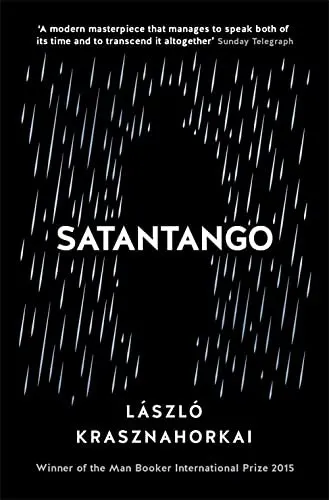
Books like Satantango
What if the promise of deliverance is merely despair learning to speak persuasively? These novels share Satantango’s fascination with hope as a trap, communities as unstable organisms, and form itself as a machinery of doom.
If you liked Satantango, you’ll love these
Not lookalikes — kindred books. Each one shares something essential with Satantango, and we tell you exactly what.
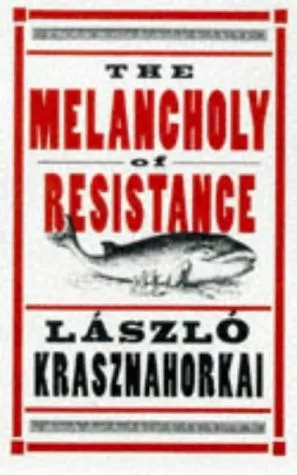
The essential next Krasznahorkai. A shabby circus arrives in a provincial town carrying a gigantic stuffed whale and rumors of a mysterious “Prince”; around it, private resentments begin organizing themselves into public menace.
The kinship lies not just in the immense, coiling sentences but in Krasznahorkai’s choreography. Viewpoints pass from crank to schemer to dreamer, transforming a whole town into one frightened consciousness. Valuska’s tavern-floor demonstration of a solar eclipse is among Krasznahorkai’s most beautiful scenes: cosmic order briefly imagined inside human disorder. This fusion of slapstick, terror, metaphysics, and exact social observation helped establish his reputation as contemporary fiction’s great master of apocalypse. If Satantango felt like a dance at the end of the world, this is the orchestra tuning up.
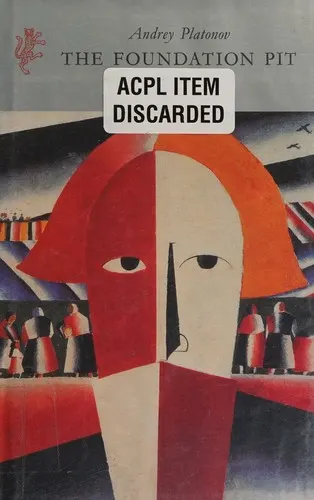
After Voshchev is dismissed from his job for thinking too much, he joins laborers excavating the foundation for an enormous communal building. Yet the harder everyone works toward the radiant future, the more bewildering the project becomes.
Platonov does with Soviet rhetoric what Krasznahorkai does with promises of renewal: he exposes the loneliness, appetite, and violence hiding inside collective hope. Official slogans buckle into metaphysical riddles; comedy arrives deadpan and leaves behind grief. The laborers are absurd without ever becoming objects of contempt, and their longing for meaning gives the novel its bruising tenderness. Written in 1930 and suppressed for decades, it is now regarded as one of the masterpieces of Soviet literature. Few books match Satantango so closely in making futile motion feel at once politically exact and cosmically terrible.
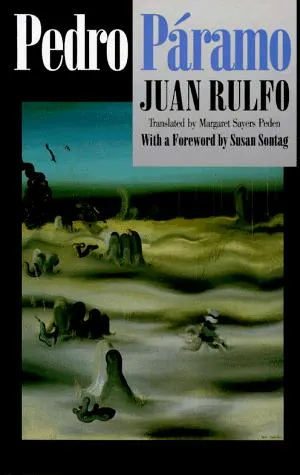
Juan Preciado travels to Comala to find the father he has never known, entering a town whose murmuring voices refuse to stay securely in the present. From that simple opening, Rulfo constructs an entire social order out of fragments: grievances, desires, memories, and half-heard testimony.
Where Krasznahorkai achieves hypnosis through accumulation, Rulfo does it through radical compression. Scenes return altered; speakers emerge before they can be identified; time folds until the reader must assemble the town’s moral history from echoes. Pedro Páramo’s power, like Irimiás’s, exists partly in what other people need him to be. Barely longer than a novella, this foundational work of Latin American modernism exerted a legendary influence on García Márquez and generations after him. It contains no wasted sentence—and somehow leaves behind a whole country of ghosts.