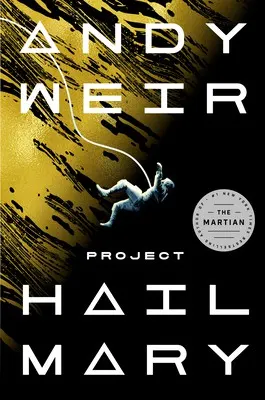
Books like Project Hail Mary
Project Hail Mary turns equations into cliffhangers, improvisation into comedy, and scientific curiosity into an unexpectedly moving form of companionship. These three novels capture different parts of that exhilarating mixture.
If you liked Project Hail Mary, you’ll love these
Not lookalikes — kindred books. Each one shares something essential with Project Hail Mary, and we tell you exactly what.
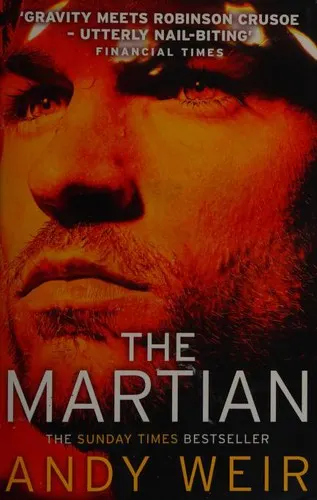
No novel delivers Weir’s signature pleasure—watching an intelligent, funny person reason his way out of apparently terminal trouble—more purely. Astronaut Mark Watney is stranded on Mars with dwindling supplies, and every chapter converts chemistry, botany, engineering, and stubbornness into suspense.
The Martian is leaner and lonelier than Project Hail Mary, but it has the same infectious faith that a problem becomes less frightening once you can measure it. The jokes are not decorations; they are how Watney keeps despair from controlling the experiment. A word-of-mouth publishing phenomenon before becoming a celebrated film, it remains the definitive modern “competence thriller.” If Ryland Grace’s improvised solutions made you want to applaud, Watney’s will make you cheer aloud.
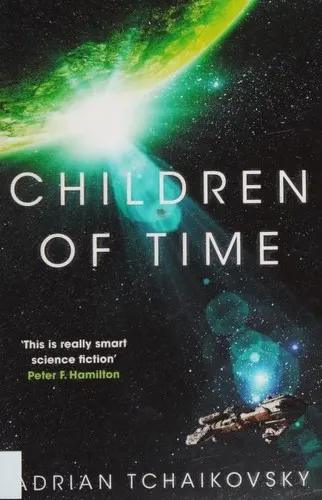
Begin this one for its vast evolutionary thought experiment; stay because Tchaikovsky makes a genuinely nonhuman intelligence startlingly understandable. As the remnants of humanity seek a new home, a failed terraforming project develops in ways its creators never anticipated. The resulting civilization is not merely humans wearing alien masks: its bodies, instincts, technologies, and social structures grow from a radically different foundation.
That is the deepest kinship with Project Hail Mary. Both books treat understanding another species as an act of patient inference—and make the accumulation of shared knowledge emotionally thrilling. Winner of the Arthur C. Clarke Award and the foundation of a much-loved series, Children of Time has become a modern landmark of big-idea science fiction. Its scale is immense, but its wonder rests on beautifully concrete discoveries.
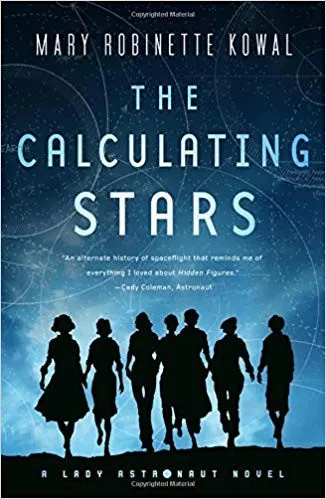
When a catastrophe makes humanity’s long-term survival uncertain, mathematician and pilot Elma York joins the effort to accelerate the space program. Kowal makes calculation tactile: trajectories must be checked, machines mastered, procedures improved, and institutional obstacles confronted by people whose expertise is too valuable to ignore.
Where Project Hail Mary gives you one scientist improvising at the edge of extinction, The Calculating Stars shows competence becoming collective—mission control, engineers, pilots, and human computers turning knowledge into momentum. Elma’s anxiety and ambition also give the technical triumphs an intimate cost. The novel won the Hugo, Nebula, and Locus awards, an unusually emphatic sweep earned by its combination of propulsion, humane characterization, and optimistic rigor. It makes spaceflight feel difficult enough to matter and possible enough to inspire.