Author
Books like Andy Weir
4 books we recommend to Andy Weir readers, drawn from Project Hail Mary and The Martian — each with the reason why.
If you loved Project Hail Mary
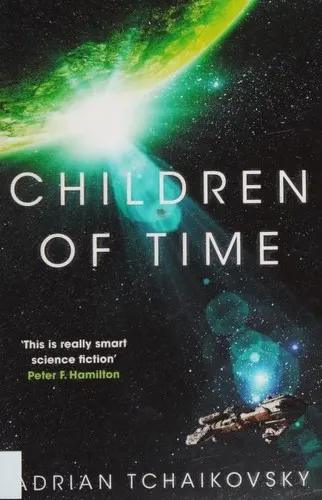
Begin this one for its vast evolutionary thought experiment; stay because Tchaikovsky makes a genuinely nonhuman intelligence startlingly understandable. As the remnants of humanity seek a new home, a failed terraforming project develops in ways its creators never anticipated. The resulting civilization is not merely humans wearing alien masks: its bodies, instincts, technologies, and social structures grow from a radically different foundation.
That is the deepest kinship with Project Hail Mary. Both books treat understanding another species as an act of patient inference—and make the accumulation of shared knowledge emotionally thrilling. Winner of the Arthur C. Clarke Award and the foundation of a much-loved series, Children of Time has become a modern landmark of big-idea science fiction. Its scale is immense, but its wonder rests on beautifully concrete discoveries.
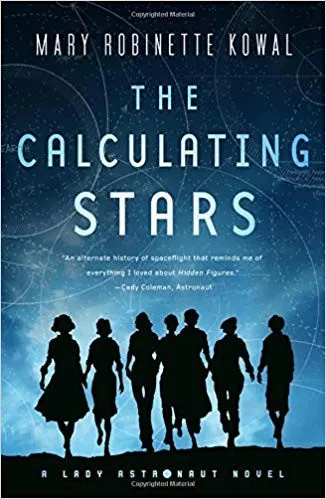
When a catastrophe makes humanity’s long-term survival uncertain, mathematician and pilot Elma York joins the effort to accelerate the space program. Kowal makes calculation tactile: trajectories must be checked, machines mastered, procedures improved, and institutional obstacles confronted by people whose expertise is too valuable to ignore.
Where Project Hail Mary gives you one scientist improvising at the edge of extinction, The Calculating Stars shows competence becoming collective—mission control, engineers, pilots, and human computers turning knowledge into momentum. Elma’s anxiety and ambition also give the technical triumphs an intimate cost. The novel won the Hugo, Nebula, and Locus awards, an unusually emphatic sweep earned by its combination of propulsion, humane characterization, and optimistic rigor. It makes spaceflight feel difficult enough to matter and possible enough to inspire.
If you loved The Martian
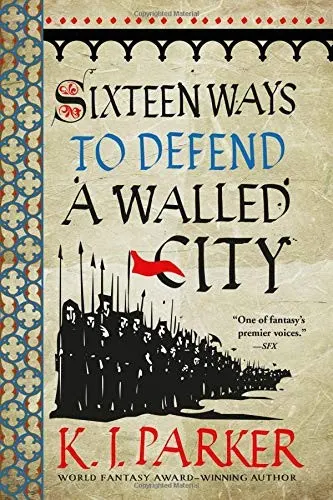
Orhan is not a heroic warrior; he is an engineer who finds himself facing a military catastrophe. He thinks in materials, labor, water, structures, incentives, and the inconvenient stupidity of institutions. Like Watney, he survives by noticing what everyone else overlooks—and narrates his improvisations with dry, irreverent wit.
Parker has a fiercely loyal readership because he turns technical reasoning into drama without sanding away moral ambiguity. This is fantasy for readers who care less about magic than about how things are built, why systems fail, and what one capable person can accomplish with inadequate tools and no good options.
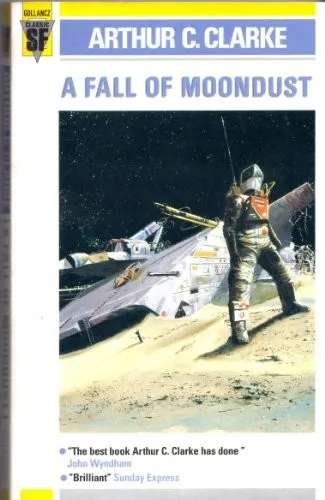
A tourist cruiser skimming across a lunar sea of dust is suddenly swallowed beneath the surface. From that wonderfully clean opening, Clarke constructs a survival-and-rescue procedural in which air, heat, pressure, and incomplete information matter more than villainy.
Hugo-nominated in 1963, it feels like a direct ancestor of The Martian’s particular pleasure: every measurement counts, every proposed solution creates fresh complications, and science is neither decoration nor magic—it is the action. Clarke’s prose is lean, lucid, and relentlessly forward-moving. Anyone who loved watching Watney reason his way through danger should read one of the classic novels that helped establish the form.