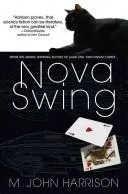
Books like Nova Swing
—because what finally haunts you is less the space-opera machinery than the sensation of reality going soft around damaged people: desire, memory, and place becoming impossible to separate. These three novels create that same dangerous intimacy without merely reproducing Harrison’s scenery.
If you liked Nova Swing, you’ll love these
Not lookalikes — kindred books. Each one shares something essential with Nova Swing, and we tell you exactly what.
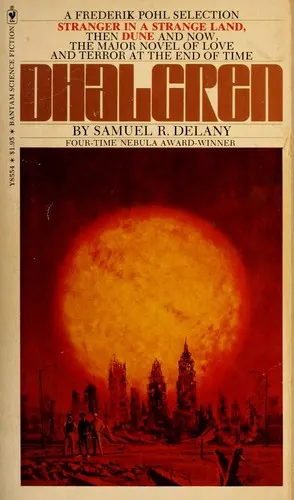
A young man enters Bellona, a city cut off from ordinary America, and finds that time, identity, and even basic facts no longer hold still. He acquires a name, joins the city’s drifting communities, and begins writing in a notebook whose relationship to the novel soon feels tantalizingly unstable.
Like Nova Swing, Dhalgren makes urban derangement sensuous rather than schematic. Its littered streets, casual sex, improvised households, rumors, and sudden beauties matter more than any promised explanation. Delany trusts repetition, contradiction, and charged encounters to create meaning; the city becomes something you inhabit rather than solve. Famously divisive yet enduringly beloved—and a rare avant-garde novel to sell more than a million copies—it helped make this kind of literary, disorienting science fiction possible. Skipping it would mean missing one of Nova Swing’s great imaginative ancestors.

An unnamed man pursues an elusive woman while walls of ice advance across the world. That premise sounds clear; the experience is anything but. Scenes recur in altered forms, fantasies invade events without warning, and obsession becomes indistinguishable from catastrophe.
Kavan’s prose is colder and more compressed than Harrison’s, but it has the same ability to make unstable reality feel physically immediate. Ice, glass, pale hair, ruined roads: each image is lucid enough to cut, even as causality dissolves. The book’s cruelty is inseparable from its beauty, and its narrator’s possessiveness is exposed rather than excused. Once an eccentric cult novel, Ice is now firmly recognized as a modern classic of speculative literature. Few books so short can leave the world looking so permanently unreliable.
After his life collapses, Peter Sinclair retreats to a friend’s cottage and begins writing an account of himself. The manuscript gradually opens onto another geography—Priest’s Dream Archipelago—and the apparent border between autobiography, invention, and lived experience becomes impossible to police.
Where Nova Swing intoxicates with grime, color, and verbal static, The Affirmation works by immaculate control. Priest keeps every sentence calm while the foundations underneath it shift. The result is not a puzzle with a reassuring solution but an exact study of how longing edits memory and how a person might choose the reality capable of containing him. Widely regarded as one of Priest’s finest novels, it rewards rereading because each interpretation quietly compromises the others. Its final effect is devastating: not confusion, but the suspicion that certainty was always the lesser thing.