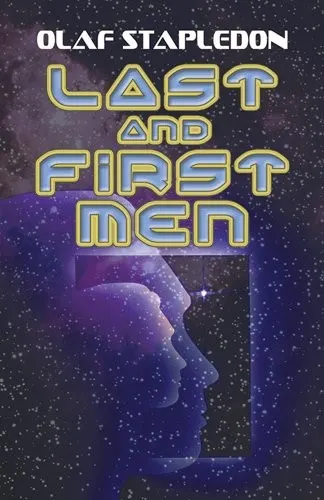
Books like Last and First Men
Reading Last and First Men produces a peculiar vertigo: whole civilizations flare up and vanish in a paragraph, yet their failures feel intimate. Its vastness does not dwarf human longing so much as expose its persistence across unimaginable change. These three novels offer that same collision of intellectual scale, evolutionary speculation, and melancholy wonder.
If you liked Last and First Men, you’ll love these
Not lookalikes — kindred books. Each one shares something essential with Last and First Men, and we tell you exactly what.
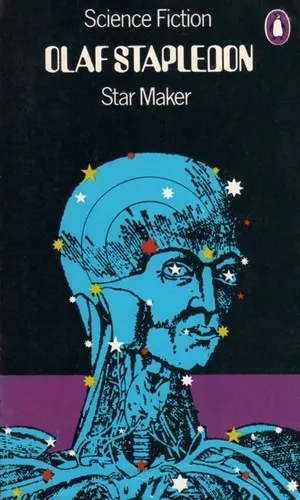
Stapledon’s next great cosmic history begins with one ordinary person gazing at the night sky, then expands beyond humanity, beyond individual minds, and eventually beyond anything resembling conventional civilization. Where Last and First Men treats our species as one unfinished experiment, Star Maker asks whether the entire universe might be understood as a sequence of creative experiments.
Its invented beings and collective intelligences are not decorative aliens; each tests an idea about community, consciousness, love, power, or spiritual maturity. The austere, visionary narration again turns abstraction into sublimity. A foundational influence on writers including Arthur C. Clarke, it remains perhaps the purest expression of Stapledon’s gift. Anyone who stops with Last and First Men has read only half of his grandest thought.
Galápagos approaches Stapledon’s most unsettling proposition—that intelligence may be neither evolution’s goal nor its greatest success—with savage comedy. A ghostly narrator looks back from a million years in the future on a group of people gathered for a troubled nature cruise in 1986, interpreting their behavior with the cruel clarity of deep time.
Vonnegut replaces Stapledon’s prophetic solemnity with jokes, abrupt judgments, and tenderness for creatures burdened by oversized brains. Yet beneath the comic voice lies the same exhilarating refusal to flatter humanity: evolution is contingent, moral progress is uncertain, and the traits we prize may be traps. Few novels make species-level speculation feel so funny, sad, and personally accusatory.
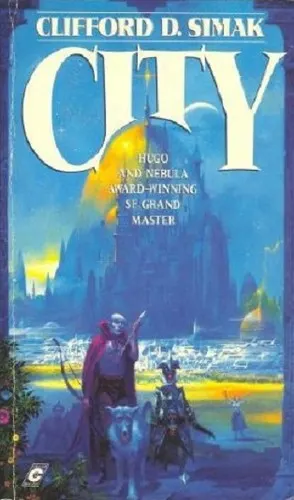
City is presented as a body of ancient legends told by dogs, whose scholars dispute whether the creature called Man ever really existed. That framing instantly removes humanity from the center of its own future and gives the book its haunting emotional distance: our ambitions become half-remembered folklore, while other forms of intelligence inherit the ethical questions we failed to settle.
Simak’s scale is immense, but his manner is pastoral and gentle rather than oracular. Robots, animals, families, and abandoned places carry the weight of historical transformation, producing an elegy for humanity without assuming humanity deserves to endure. This quietly influential classic won the International Fantasy Award and remains beloved for its rare combination of cosmic perspective and humane sorrow. Its final effect is not apocalypse but a profound, almost tender estrangement from our own species.