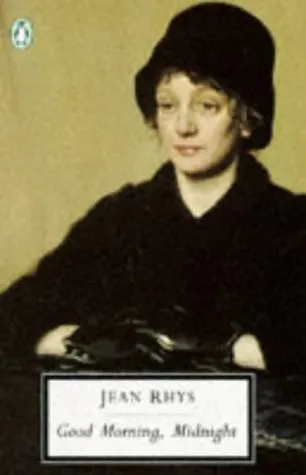
Books like Good Morning, Midnight
How do you keep living when every mirror, rented room, and stranger’s glance seems to say that your life is already over? These three novels share Rhys’s rare combination of desolation, black comedy, formal precision, and compassion without consolation.
If you liked Good Morning, Midnight, you’ll love these
Not lookalikes — kindred books. Each one shares something essential with Good Morning, Midnight, and we tell you exactly what.
Judith Hearne arrives at a Belfast boarding house with shabby possessions, dwindling money, and a stubborn belief that respectability, romance, or religion might yet rescue her. Like Sasha Jansen, she survives by arranging small illusions around an unbearable loneliness—and by hiding her dependence on drink until she can no longer do so.
Moore’s great achievement is to expose Judith’s fantasies without treating her as a joke. Every strained conversation and misread kindness carries the threat of humiliation. The prose moves between cruel social observation and intimate sympathy, making the reader feel both how others see Judith and how desperately she needs not to see herself that way. The novel established Moore’s formidable reputation, and its unsparing tenderness makes it one of the essential portraits of loneliness in twentieth-century fiction.
Where Rhys draws us deep inside a woman’s wounded consciousness, Spark creates terror by withholding it. Lise, dressed in aggressively clashing colors, leaves on a journey whose violent destination the novel signals almost immediately. She seems at once frighteningly deliberate and impossible to understand.
Spark compresses an entire psychic catastrophe into a short, glitteringly sharp book. Shop assistants, hotel clerks, and fellow travelers enforce the same petty codes of femininity and acceptable behavior that torment Sasha, but Lise answers them with manic provocation. The result is colder and more formally audacious than Rhys: a reverse mystery, an anti-psychological character study, and one of Spark’s most fiercely admired novels. Its brevity only intensifies its power; once read, it is difficult to dislodge.
Maria Wyeth drives the Los Angeles freeways because motion is easier than thought. Around her, Hollywood reduces experience to appointments, transactions, and empty talk; Didion reduces the novel itself to brief chapters, white space, repetitions, and sentences stripped nearly bare.
A reader who loves Rhys’s ability to make despair sound lucid will recognize the force of Maria’s flat, exact voice. Both novels understand that breakdown is not always dramatic: it can look like choosing a dress, ordering another drink, memorizing routes, or answering a question with practiced indifference. Yet Didion’s coolness is not emptiness. Feeling accumulates beneath the immaculate surface until every ordinary detail seems charged with dread. A touchstone of American minimalism, this is one of those rare novels whose style becomes a way of seeing long after the final page.