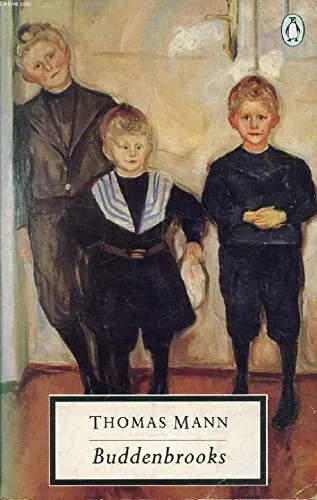
Books like Buddenbrooks
The happiest reader of Buddenbrooks relishes the slow accumulation of telling details: the meal, marriage, business decision, or social embarrassment through which a family—and eventually an entire way of life—reveals its fragility. These novels offer that same union of intimate observation, historical change, irony, and elegy.
If you liked Buddenbrooks, you’ll love these
Not lookalikes — kindred books. Each one shares something essential with Buddenbrooks, and we tell you exactly what.
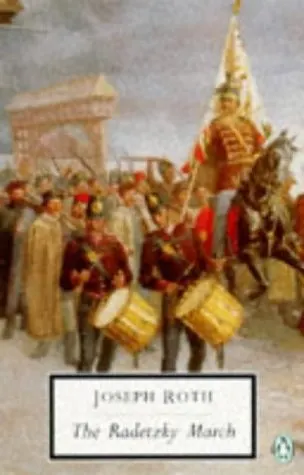
Roth achieves in a shorter span what Mann does across generations: he makes a family's decline inseparable from the collapse of the world that gave it meaning. The Trottas owe their status to an act of heroism at Solferino, but the legend soon hardens into a burden inherited by men less able to inhabit it.
The kinship lies above all in tone. Roth regards uniforms, ceremonies, official portraits, and paternal authority with exquisite irony, yet he never sneers at those who depend on them. Like Mann, he understands that obsolete institutions can remain emotionally indispensable. The result is one of the great novels of the Austro-Hungarian Empire: lucid, melancholy, and devastating precisely because its doomed world is rendered with such tenderness.
If the social comedy of Buddenbrooks delighted you as much as its tragedy, The Maias is essential. Eça places the cultivated young Carlos da Maia in a grand Lisbon household whose confidence, taste, and inherited position conceal deeper forms of exhaustion. Around him swirls a society of fashionable doctors, journalists, politicians, artists, and professional conversationalists, all brilliantly alive and mercilessly observed.
Eça's irony is quicker and more sparkling than Mann's, but it serves a similar purpose: every drawing room and dinner becomes a test of whether refinement is genuine or merely decorative. The novel's architecture is extraordinarily assured, gradually turning comedy into something far more painful without sacrificing its wit. Widely regarded as Eça's masterpiece and a summit of Portuguese fiction, it offers the rare pleasure of a vast social novel in which nearly every polished sentence carries a small blade.
Tanizaki's masterpiece begins with an apparently modest family problem: finding a suitable husband for one of four sisters. But each prospective match exposes another tension between family prestige, money, personal desire, and the demands of a changing society. Reputation is maintained through letters, visits, clothes, tactful omissions, and exhausting negotiations—the domestic machinery of status that Mann understood so well.
What makes the novel irresistible is its patience. Tanizaki lets seasons, festivals, illnesses, and tiny breaches of decorum gather emotional force until an entire threatened order seems present in a kimono choice or a delayed reply. The sisters are not symbols but sharply distinct, complicated women, and the novel's beauty never prettifies their constraints. Few books make ordinary family rituals feel so absorbing—or make their gradual disappearance seem like such an immense loss.