Author
Books like Ann Leckie
9 books we recommend to Ann Leckie readers, drawn from Ancillary Justice, Translation State and The Raven Tower — each with the reason why.
If you loved Ancillary Justice

Captain Kel Cheris is ordered to share her mind with the preserved consciousness of Shuos Jedao, a brilliant, centuries-dead general—and notorious mass murderer. Their uneasy coexistence recalls Breq’s divided identity without simply reproducing it: every conversation becomes a contest over trust, agency, and who is using whom.
Lee also makes empire feel embedded in thought itself. Here, state power is sustained by ritual, mathematics, and collective belief; even the laws of physics enforce conformity. A Hugo finalist and Locus winner, this is uncompromising military science fiction whose initial strangeness pays off magnificently. If you loved how Leckie made cognition, language, and imperial violence inseparable, missing Cheris and Jedao would mean missing one of the genre’s great pairings.
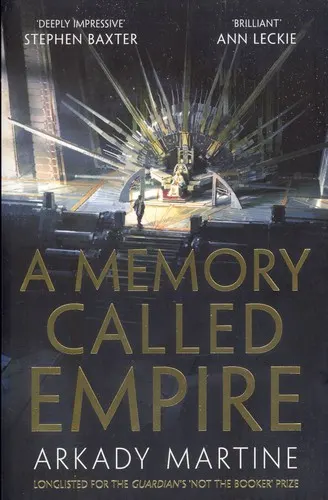
Mahit Dzmare arrives at the heart of the Teixcalaanli Empire carrying an implanted copy of her predecessor’s memories—only to discover that the copy is outdated and the predecessor is dead. The device is not merely technological cleverness: it turns identity into an intimate political problem, as Mahit must decide which thoughts are hers while navigating a culture she has admired all her life.
The kinship with Ancillary Justice lies especially in the novel’s ambivalence toward empire. Teixcalaan is predatory, but also dazzling: its poetry, etiquette, and wordplay exert a seduction that military force alone never could. Winner of the Hugo Award for Best Novel, Martine’s debut understands that domination is most dangerous when the dominated genuinely love parts of it. Its diplomatic suspense is excellent; its portrait of cultural longing is unforgettable.
Maya Andreyeva is a reporter whose senses are transmitted through technology and monitored by an unseen editor. Her very consciousness has become part workplace, part surveillance apparatus, and part battleground. Carter uses that premise to ask who owns experience—and whether an authentic self can survive when perception is mediated, recorded, and corrected by power.
Where Leckie gives consciousness the scale of a starship, Carter traps it inside an invasive network, producing something darker, stranger, and unnervingly intimate. Long cherished as a cult classic, the novel returned to print in a Tor Essentials edition introduced by Ann Leckie herself. That endorsement makes sense: few novels so rigorously join speculative technology to questions of personhood, complicity, and moral courage.
If you loved Translation State

This is the closest match for Leckie’s rare combination of humane first contact, queer domestic life, and serious political argument. When aliens arrive offering to rescue humanity, Earth is no longer organized solely around familiar states and corporations; watershed communities and unconventional families have built new ways of sharing power.
Emrys makes negotiation thrilling because every disagreement rests on incompatible ideas about kinship, survival, and responsibility. Like Translation State, the novel refuses to separate civilization-shaping diplomacy from meals, children, attraction, and household friction. Its aliens are neither monsters nor uncomplicated saviors, and its warmth never blunts its intellectual bite. If you loved watching Leckie turn family into a contested political category, this generous, ingenious novel is indispensable.
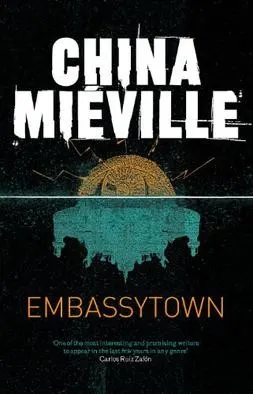
Read this for the vertigo of Qven’s chapters: the sense that language, consciousness, and the body might fit together in ways humans can barely apprehend. On a remote world, human ambassadors communicate with the indigenous Ariekei, whose Language can be spoken only under extraordinary conditions. Then one new arrival destabilizes that relationship.
Miéville does not merely give his aliens unusual customs; he constructs a form of mind that changes what truth, metaphor, and speech can mean. The result is stranger and more demanding than Translation State, but it shares Leckie’s conviction that confronting radical difference should transform everyone involved. A Locus Award winner and one of Miéville’s most admired novels, Embassytown is the book to read when ordinary fictional aliens have begun to seem disappointingly human.
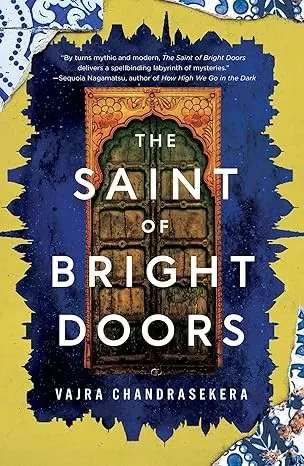
Fetter was raised to assassinate his messianic father. Instead, he reaches the city of Luriat, joins a support group for people burdened by grand destinies, and encounters mysterious doors that everyone has trained themselves not to notice.
That premise opens into a dazzling examination of imposed identity. Chandrasekera shares Leckie’s gift for making bureaucracy absurd, menacing, and metaphysically consequential: official categories do not merely describe people but determine whose existence counts. Yet the novel remains slyly funny, alive to friendship, and deeply sympathetic to anyone trying to escape the role assigned by family or society.
Winner of both the Nebula and Crawford awards, The Saint of Bright Doors is one of the most original speculative debuts of recent years. Its world is unlike Leckie’s, but its central question is unmistakably kindred: how do you become a person when powerful systems have already decided what you are?
If you loved The Raven Tower

Mantel’s Booker Prize winner turns political maneuvering into an almost supernatural art. Through Thomas Cromwell’s alert, calculating consciousness, every audience and casual remark becomes a contest over what may be said, what must remain implied, and whose version of events will harden into truth.
That is precisely the pressure that makes The Raven Tower so gripping: intelligence operating under constraints. Mantel’s startling present-tense prose places you beside Cromwell as he reads rooms, silences, debts, and threats. If you loved Leckie’s fusion of austere voice, dangerous language, and succession politics, Wolf Hall offers the same cerebral suspense with extraordinary psychological force.
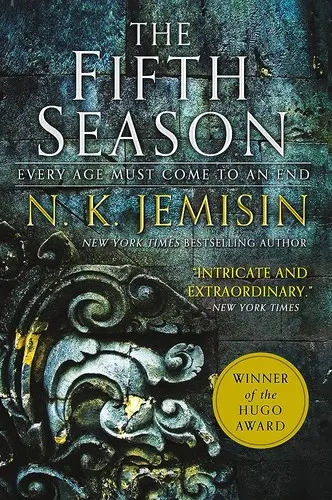
Here is another novel that makes point of view part of its mystery rather than merely its delivery system. Jemisin moves among narrative persons—including a commanding second-person voice—while gradually teaching you how to read a civilization shaped by catastrophe, coercion, and geological time.
The kinship with The Raven Tower lies not simply in stone and deep history, but in the way both books make apparently inert things morally and politically charged. Jemisin asks who gets treated as a person, who is used as a tool, and what accumulated suffering does to the world. The first novel ever followed by two sequels that each also won the Hugo, it begins a trilogy whose formal ambition is matched by its emotional devastation.

Samatar dismantles the traditional epic from inside. Four women—a soldier, a scholar, a poet, and a socialite—tell intersecting stories of rebellion, empire, faith, and the narratives nations use to justify themselves. Their voices do not fit together neatly; the resulting tensions are the book’s revelation.
Readers who admired how Leckie reworked Hamlet without becoming subordinate to it will recognize Samatar’s equally fearless relationship with inherited fantasy. Battles matter, but so do translation, scripture, songs, and the meanings imposed on other people’s lives. Samatar’s sensuous, intellectually exact prose has made the novel a treasured cult work of literary fantasy: demanding, haunting, and unlike the supposedly grand epics it quietly surpasses.