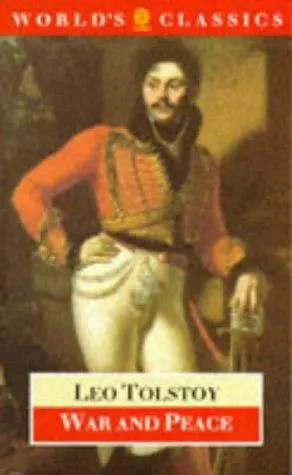
Books like War and Peace
Readers return because Tolstoy’s world seems to grow as they do: youthful longing, family comedy, moral bewilderment, historical catastrophe, and ordinary happiness reveal different meanings at every age. These three novels offer that same rare abundance in distinct ways.
If you liked War and Peace, you’ll love these
Not lookalikes — kindred books. Each one shares something essential with War and Peace, and we tell you exactly what.
No novelist rivals Tolstoy more closely in the humane art of revising our judgments. In a provincial English town, Dorothea Brooke longs to devote herself to something great, while doctors, clergy, landowners, and hopeful young couples pursue designs of their own. Eliot moves among them with the same balance of irony and mercy that makes even Tolstoy’s vain or foolish characters impossible to dismiss.
The scale here is social rather than military, but the achievement is comparably panoramic: private choices ripple through marriages, careers, inheritances, and an entire community. Virginia Woolf famously called it “one of the few English novels written for grown-up people,” and its stature has only increased. If you treasure War and Peace for teaching you to see more generously, Middlemarch is indispensable.
Grossman took Tolstoy’s capacious form into the darkest machinery of the twentieth century. Around the Battle of Stalingrad, he follows a vast network of soldiers, scientists, mothers, prisoners, bureaucrats, and children, giving each consciousness its irreducible weight. History is immense, but never abstract: an official doctrine, a military order, or a moment of private cowardice enters kitchens and friendships as decisively as an army enters a city.
The Soviet authorities considered the novel so dangerous that the manuscript itself was seized; a surviving copy was smuggled abroad and published years later. That history matters because the book’s moral argument is embodied in its very existence: systems demand simplification, while the novel insists on the stubborn complexity of persons. Among modern epics, this is War and Peace’s most formidable heir—and one of the few books vast enough to make history feel both crushing and intimately human.

It begins with a mother announcing at a wedding that her daughter will be next. From that wonderfully deft opening, Vikram Seth unfolds four interconnected families in newly independent India, where courtship, religion, elections, ambition, and generational conflict continually reshape one another.
What makes the novel Tolstoyan is not merely its famous length or crowded cast, but its pleasure in the full variety of living. Seth can pass from comedy to heartbreak, from domestic bargaining to public upheaval, without treating any sphere as less real than another. His characters are not representatives placed on a historical map; they are contradictory people whose affections make politics personal and whose compromises make ideals costly. Winner of the Commonwealth Writers’ Prize and beloved by generations of readers, A Suitable Boy is the kind of book one finishes feeling not that one has followed a plot, but that one has inhabited a civilization.