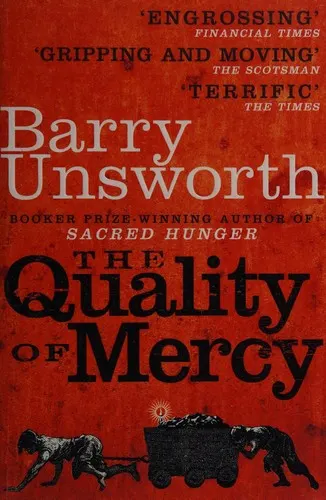
Books like The Quality of Mercy
What lingers is a hunger for historical fiction that makes commerce, law and conscience feel inseparable—novels spacious enough to expose a whole society, yet intimate enough to show the private cost of complicity.
If you liked The Quality of Mercy, you’ll love these
Not lookalikes — kindred books. Each one shares something essential with The Quality of Mercy, and we tell you exactly what.
If you have not read the novel that precedes The Quality of Mercy, it is indispensable. Unsworth follows the building and outfitting of a Liverpool slave ship, moving between investors, sailors and captives while tracing how ordinary appetites—for profit, status, security and power—harden into atrocity.
Winner of the Booker Prize, Sacred Hunger is broader, darker and more immersive than its sequel. Its great achievement is to make an economic system dramatically alive without reducing anyone to a mouthpiece. The moral reckoning in The Quality of Mercy acquires its full, devastating weight here.

Twenty narrators crowd into this fiercely intelligent voyage to nineteenth-century Tasmania: sailors, settlers, officials, Aboriginal people and a deluded clergyman convinced that Eden lies at journey’s end. Their voices contradict one another, often comically, until the comedy reveals the evasions by which conquest becomes respectable.
Like Unsworth, Kneale understands that historical evil is sustained not only by monsters but by contracts, theories, ambitions and convenient vocabulary. Winner of the Whitbread Book of the Year and shortlisted for the Booker, English Passengers combines panoramic storytelling with lethal irony. Few novels make imperial self-deception so entertaining—or so difficult to forget.

Eliza Touchet, intelligent, skeptical and constrained by her position in a celebrated novelist’s household, becomes fascinated by the sensational Tichborne trial. Around that public spectacle, Smith constructs a searching novel about who is believed, who gets to tell history and how British respectability depends upon suffering kept safely elsewhere.
The kinship with The Quality of Mercy lies in its distrust of moral theater. Courtrooms and reformist convictions may promise justice, but both novels keep asking what happens when sympathy costs its possessor something. Smith’s first historical novel is crowded, argumentative and wonderfully alert to hypocrisy; miss it and you miss one of the sharpest recent dissections of the stories a nation tells to acquit itself.