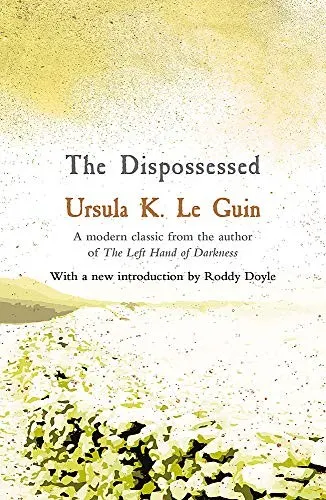
Books like The Dispossessed
A wall surrounds Anarres’s spaceport, and in the first pages Shevek crosses the boundary that most of his world has learned not even to approach. These novels likewise treat utopia not as a destination but as a difficult crossing—one that exposes every compromise in the society left behind.
If you liked The Dispossessed, you’ll love these
Not lookalikes — kindred books. Each one shares something essential with The Dispossessed, and we tell you exactly what.
On the ocean moon Shora, the Sharers have built an egalitarian, ecologically intimate culture without property, hierarchy, or institutional violence. Slonczewski makes that society as materially convincing as Anarres: its principles live in language, child-rearing, scientific practice, and daily work rather than in slogans.
What makes this Campbell Memorial Award winner exceptional is the pressure it places on its ideals. When an expansionist power turns toward Shora, nonviolence becomes not a badge of moral purity but a demanding technology of resistance. Slonczewski, herself a biologist, gives the novel’s ecological thinking unusual authority, while the Sharers’ fierce internal arguments prevent them from becoming saintly abstractions. Few novels have carried forward Le Guin’s fusion of anthropology, science, and anarchist ethics so persuasively.
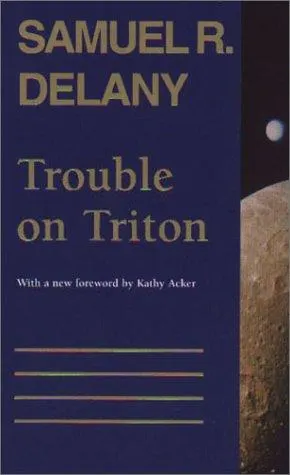
Delany’s subtitle, “An Ambiguous Heterotopia,” deliberately answers Le Guin’s “Ambiguous Utopia.” Triton offers astonishing freedom: people can alter their bodies, genders, affiliations, and living arrangements, while neighborhoods organize themselves around almost any shared preference. Yet its protagonist, Bron, remains aggrieved and dissatisfied. The question is no longer merely whether society can liberate a person, but whether a person can endure the freedom and reciprocity liberation requires.
Delany’s wit is sharper and his method more abrasive than Le Guin’s. He turns political theory inward, examining vanity, resentment, desire, and the habit of treating other people as supporting characters. The result is a major work of New Wave science fiction and one of the most searching literary conversations with The Dispossessed ever written. Reading it feels less like visiting another utopia than discovering the argument Le Guin’s novel makes possible.

Connie Ramos begins in a world that has stripped her of credibility and control; from that brutal immediacy, Piercy opens a connection to a possible future organized around communal labor, ecological restraint, shared child-rearing, and participatory decision-making. Like Le Guin, she knows that a political vision becomes believable through kitchens, arguments, sexual arrangements, boring chores, and the distribution of care.
But Piercy gives utopian speculation the urgency of a struggle over who gets to define reality. Connie’s encounters with the future are inseparable from poverty, racism, psychiatric power, and the institutional language used to silence her. A landmark of feminist speculative fiction, the novel has retained devoted readers because its imagined society is inviting without being frictionless—and because its anger at the present never overwhelms its capacity to imagine otherwise. If The Dispossessed made political possibility feel intimate, Woman on the Edge of Time makes it feel fiercely necessary.