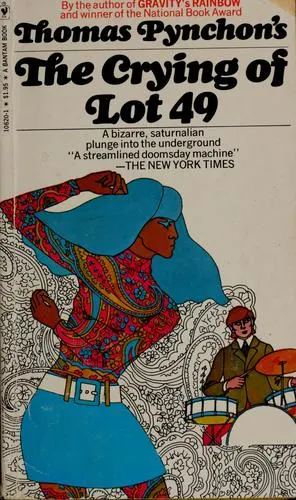
Books like The Crying of Lot 49
Begin with a ninety-two-year-old woman given an ear trumpet and packed off to an institution: Leonora Carrington’s premise sounds far removed from Pynchon, but her heroine soon discovers that official explanations are only flimsy covers stretched over stranger systems. All three novels below turn interpretation into an intoxicating, comic and slightly terrifying activity.
If you liked The Crying of Lot 49, you’ll love these
Not lookalikes — kindred books. Each one shares something essential with The Crying of Lot 49, and we tell you exactly what.
Marian Leatherby, nearly deaf and serenely eccentric, receives a hearing trumpet that lets her overhear her family’s plan to institutionalize her. The home she enters—run by dubious authorities and decorated with an unsettling portrait—begins generating clues faster than any reasonable worldview can contain them.
Like Oedipa Maas, Marian is a woman whom society underestimates and who responds by becoming an investigator of hidden arrangements. Carrington’s comedy has Pynchon’s gift for making institutions simultaneously ridiculous and menacing, while her surrealism keeps enlarging the possibilities of what the clues might mean. A cult classic by one of Surrealism’s great figures, it is funny, emancipatory and gloriously ungovernable.

A mysterious cultural contagion called Jes Grew is sweeping 1920s America, making people dance, improvise and cast off respectable restraint. Arrayed against it is a secret order devoted to control. Reed presents their struggle through headlines, photographs, diagrams, footnotes, abrupt cuts and counterfeit scholarship until the novel itself seems infected.
This is the closest match for the exhilaration of Pynchon’s alternative postal network: buried histories become active forces, conspiracy is both explanatory tool and trap, and parody exposes what official culture has edited out. Yet Reed’s rhythm and argument are entirely his own. A National Book Award finalist and a landmark of American postmodernism, Mumbo Jumbo does not merely describe a counterculture—it performs one on the page.
A fugitive hiding on an apparently deserted island begins seeing impeccably dressed visitors who repeat peculiar gestures and conversations. He watches, records and theorizes, trying to determine whether they are real, supernatural or part of some mechanism he has not yet understood.
Bioy Casares gives the interpretive vertigo of The Crying of Lot 49 a crystalline, almost mathematical form. Every recurrence might be evidence; every theory makes the observer’s own position less secure. The novel is brief enough to feel like a trap snapping shut, yet emotionally charged by loneliness and desire. Borges famously praised its plot as perfect, and generations of readers have treated this Argentine classic as a small, inexhaustible machine: once read, it permanently alters the meaning of repetition, spectatorship and reality.