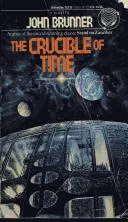
Books like The Crucible of Time
Can a truly alien intelligence learn what the universe is doing—and build a civilization capable of surviving the answer? These novels make that question thrilling in three very different ways.
If you liked The Crucible of Time, you’ll love these
Not lookalikes — kindred books. Each one shares something essential with The Crucible of Time, and we tell you exactly what.
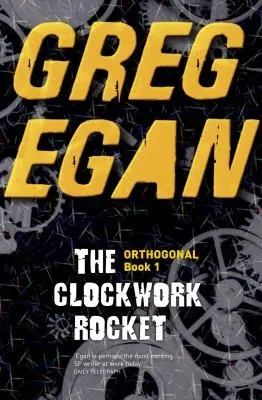
This is perhaps the closest heir to Brunner’s fusion of alien biology, scientific discovery, and species-wide peril. Yalda belongs to a life-form whose reproduction, family structures, and social inequalities arise from a biology unlike ours; she also inhabits a universe governed by different physical laws. When astronomers detect a cosmic threat, understanding nature becomes a practical race for survival.
Egan does not merely decorate the story with exotic physics. He recreates the exhilaration of forming hypotheses, devising experiments, and watching knowledge overturn custom—the very process that gives The Crucible of Time its unusual grandeur. Few hard-SF novels are this intellectually audacious, and fewer still make their audacity serve such an urgent, humane story.
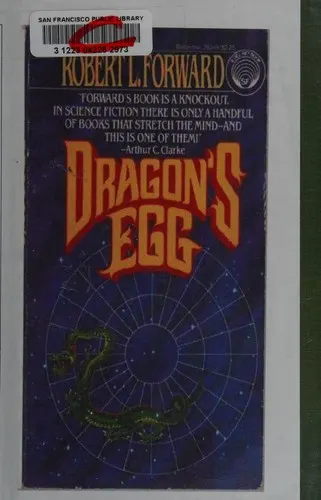
On the surface of a neutron star, the cheela live at a rate so accelerated that entire eras of their history pass during a short human observation mission. Forward follows their emergence into science and civilization while taking the crushing gravity, nuclear matter, and rapid timescale seriously.
The kinship lies in its confidence that an alien people’s intellectual history can itself be a gripping narrative. Inventions are not convenient plot devices: each is a conquest over ignorance, and each changes what the cheela can imagine. Written by a physicist and long regarded as a touchstone of hard science fiction, Dragon’s Egg delivers the rare pleasure of watching minds become equal to an almost inconceivable environment.
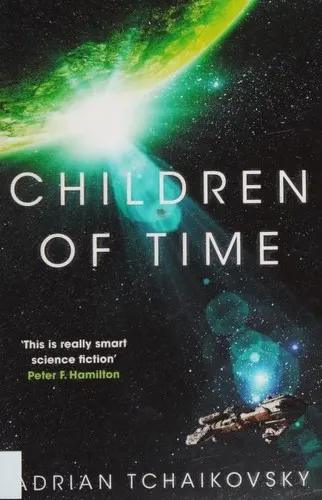
A ruined terraforming project leaves another species to inherit an intended human future. Across generations, Tchaikovsky shows intelligence emerging through bodies, instincts, inherited knowledge, and social arrangements that remain recognizably nonhuman rather than becoming humanity in disguise.
Where Brunner emphasizes civilization’s long struggle to understand and survive, Tchaikovsky makes evolution and culture interact: anatomy shapes technology, technology reshapes society, and old solutions become the foundations of new problems. Winner of the Arthur C. Clarke Award and now one of modern science fiction’s most passionately recommended novels, it earns that devotion by making alien consciousness not merely plausible but emotionally compelling. Its final achievement is to enlarge the reader’s idea of who can possess a history.