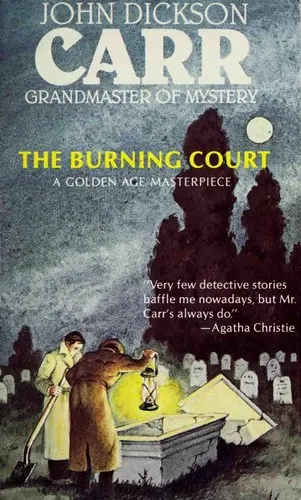
Books like The Burning Court
On the train home, Edward Stevens opens a manuscript and sees his wife’s face in the portrait of a seventeenth-century poisoner. These novels likewise make the supernatural feel disturbingly plausible without surrendering the pleasures of detection.
If you liked The Burning Court, you’ll love these
Not lookalikes — kindred books. Each one shares something essential with The Burning Court, and we tell you exactly what.
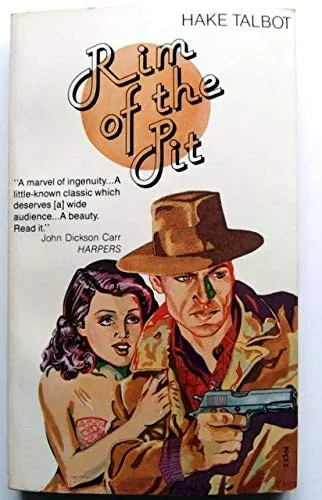
At an isolated, snowbound lodge, a séance is arranged to obtain a dead man’s consent to a business scheme. From that deliciously dubious premise, Talbot constructs a contest between occult terror and exacting fair-play detection.
Like The Burning Court, it keeps rational and supernatural explanations alive simultaneously, piling impossibility upon impossibility without dispelling the wintry dread. Its audacity is legendary among locked-room devotees: in Edward D. Hoch’s celebrated 1981 poll of experts, it placed second only to Carr’s The Hollow Man. Anyone who loves Carr at his most extravagant should experience the rare novel enthusiasts have spent decades pressing into one another’s hands.
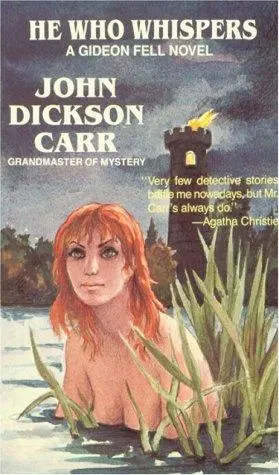
A nearly deserted meeting of the Murder Club leads to the story of a man slain atop an inaccessible medieval tower—and of Fay Seton, the magnetic young woman whispered to be a vampire.
This is Carr returning to The Burning Court’s richest territory: historical violence leaking into the present, an apparently impossible murder, and a woman whose dangerous allure makes supernatural suspicion feel less like superstition than temptation. Yet He Who Whispers is more intimate and emotionally charged, especially in its treatment of loneliness, desire, and collective cruelty. Regularly counted among Carr’s masterpieces, it proves that his finest puzzles do not merely baffle; they haunt.
A detective prevents a young woman from killing herself and hears why she has lost hope: a sequence of uncannily accurate predictions now culminates in the appointed hour of her father’s death.
Woolrich offers less of Carr’s architectural playfulness but matches his unnerving question: what happens when evidence begins to favor the impossible? Every attempt to investigate the prophecy tightens its hold, turning clocks, streets, and ordinary coincidences into instruments of dread. Woolrich, one of noir’s defining writers, was unmatched at making fatalism physically palpable. If The Burning Court’s lingering supernatural doubt mattered as much as its solution, this novel’s gathering darkness is indispensable.