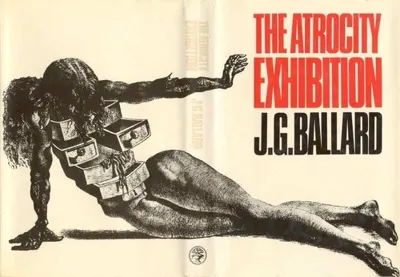
Books like The Atrocity Exhibition
Ann Quin’s Tripticks turns public language into shrapnel; Tom McCarthy’s Satin Island compresses it into the frictionless surface of a corporate report. Between those extremes, David Ohle’s Motorman builds an entire reality from the damaged signals. All three treat the novel less as a window onto the world than as a machine for exposing what modern images have done to consciousness.
If you liked The Atrocity Exhibition, you’ll love these
Not lookalikes — kindred books. Each one shares something essential with The Atrocity Exhibition, and we tell you exactly what.
Quin’s final novel is the closest thing here to Ballard’s collision of fiction, advertising copy, pornography, psychiatry, and political spectacle. A chase narrative keeps trying to emerge, only to be overwhelmed by slogans, fantasies, diagrams, voices, and sudden changes of register. Like The Atrocity Exhibition, it does not merely describe media saturation: its sentences have been invaded by it.
Quin was a central figure in Britain’s 1960s experimental underground, and Tripticks has become the cult culmination of her brief, fiercely original career. It is funnier and more manic than Ballard, but just as ruthless about consumer desire and the synthetic identities it manufactures. Anyone exhilarated by Ballard’s refusal of ordinary narrative should experience Quin pushing that refusal toward comic delirium.
Motorman opens onto a world with multiple suns, artificial organs, inexplicable bureaucracies, and messages whose authority exceeds their meaning. Ohle presents these impossibilities in flat, unastonished prose, so that the grotesque becomes administrative routine. That deadpan estrangement is profoundly Ballardian: psychological damage, institutional control, and bodily technology fuse into one climate.
First published in 1972 and sustained ever since by devoted readers and small-press rediscovery, Motorman is a genuine American cult novel—compact, funny, sinister, and almost impossible to assimilate. It feels less like conventional dystopia than an artifact recovered from a civilization adjacent to ours. Ballard readers will recognize the peculiar thrill of entering a nightmare that behaves as though nothing is wrong.
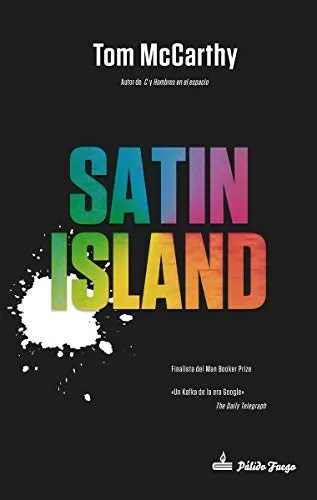
U., a corporate anthropologist, has been commissioned to produce a grand report explaining the contemporary world. Instead, his attention circulates among data, disasters, infrastructure, screens, and scraps of public imagery. The result is a novel about the seductive possibility that apparently unrelated events might form a hidden pattern—and the suspicion that pattern-making itself has become another corporate technology.
Where Ballard uses violent montage, McCarthy uses immaculate, recursive calm. Yet both understand catastrophe as something consumed aesthetically before it is understood morally. Shortlisted for both the Booker Prize and the Goldsmiths Prize, Satin Island is one of the sharpest twenty-first-century descendants of Ballard’s experimental method: a sleek, unsettling book that makes information itself feel pathological.