
Books like Norwegian Wood
Norwegian Wood leaves the ache of having inhabited a memory too beautiful to revisit and too painful to escape—a world where desire, music, death, and ordinary tenderness have become inseparable.
If you liked Norwegian Wood, you’ll love these
Not lookalikes — kindred books. Each one shares something essential with Norwegian Wood, and we tell you exactly what.
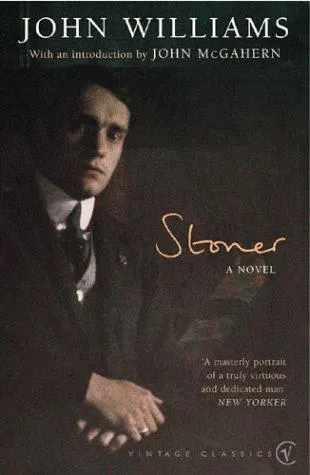
Like Norwegian Wood, Stoner finds enormous emotional force in restraint. It follows an unremarkable man through love, disappointment, work, and the quiet consequences of choices he barely understood while making them. Williams’s lucid prose never begs for tears; it simply places each loss with such precision that the accumulated weight becomes devastating.
Long neglected and later embraced as a modern classic, Stoner inspires unusual devotion because it makes an ordinary life feel singular and irreplaceable. If Murakami’s reflective narrator moved you, Williams’s even quieter reckoning may feel like discovering the same melancholy stripped to its purest form.

A chance encounter causes the narrator to remember a secret adolescent love, and the past returns with the immediacy of a song heard after decades. Besson captures the intoxication of first intimacy alongside the knowledge that youth cannot protect anyone from shame, silence, or time.
Translated with exceptional clarity by Molly Ringwald, this slender autobiographical novel has won devoted readers by accomplishing in roughly 150 pages what many books cannot do in five hundred. Its final emotional effect is disproportionate to its size: private, piercing, and almost impossible to shake.

Makkai expands one of Norwegian Wood’s deepest concerns—the bewildering experience of surviving people you love—onto a communal scale. Beginning amid the AIDS crisis in 1980s Chicago and reaching toward contemporary Paris, the novel follows friendships made more urgent by the knowledge that every gathering may soon contain an absence.
Yet this is not simply a tragedy. It is alive with wit, art, desire, resentment, and the practical labor of caring for others. A Pulitzer Prize and National Book Award finalist, The Great Believers earned that recognition by refusing to turn grief into abstraction: every loss alters the texture of the lives that continue. Readers drawn to Murakami’s mixture of erotic intensity, survivor’s guilt, and stubborn tenderness will find here a larger, more socially expansive masterpiece.