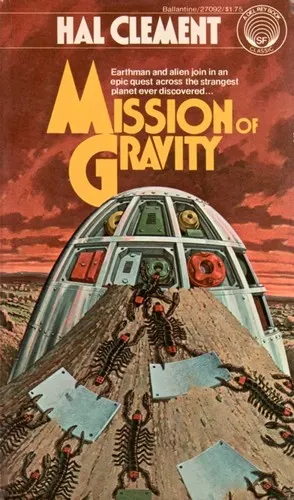
Books like Mission of Gravity
Dragon’s Egg pushes physical extremity to a breathtaking limit; The Clockwork Rocket goes further still by rebuilding physics itself. Between them, and Brunner’s richly alien saga, these novels capture Clement’s rare combination of scientific rigor, discovery, and delight in intelligent beings solving formidable problems.
If you liked Mission of Gravity, you’ll love these
Not lookalikes — kindred books. Each one shares something essential with Mission of Gravity, and we tell you exactly what.
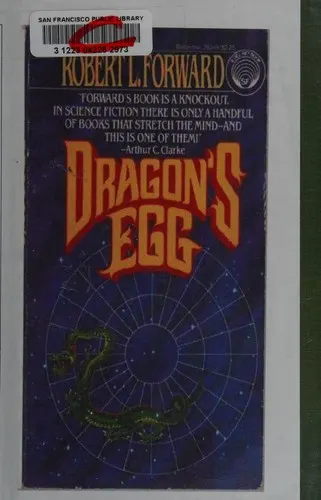
Forward, a physicist as well as a novelist, imagines life on a neutron star and follows the consequences with Clement-like discipline: gravity, scale, chemistry, perception, and time all shape what his creatures can become. The pleasure lies not merely in the exotic environment but in watching speculation turn into a coherent world.
Like Barlennan, Forward’s aliens are neither curiosities nor disguised humans. They investigate, improvise, and build their own understanding of nature. Long regarded as a landmark of extreme hard science fiction, Dragon’s Egg delivers the exhilarating sense that an impossible world has become briefly, astonishingly real.

Egan offers perhaps the purest modern continuation of Clement’s method. Its alien universe obeys different physical laws, and those laws are not ornamental: they govern light, motion, biology, technology, and the looming crisis that drives the story. The reader must learn alongside the characters, with each discovery opening new possibilities rather than merely supplying exposition.
Yet this is also a novel about who gets to pursue knowledge, what a society owes its scientists, and how intellectual courage becomes practical courage. Egan’s Orthogonal trilogy has a devoted reputation among hard-SF readers for refusing shortcuts; its opening volume makes scientific comprehension feel genuinely heroic.
What if the most compelling part of Mission of Gravity for you was Barlennan himself—the pleasure of inhabiting a genuinely nonhuman mind whose curiosity and ingenuity matter? Brunner builds an entire novel around that pleasure. With no human viewpoint to steady the reader, an alien civilization confronts natural upheaval through observation, argument, invention, failure, and accumulated knowledge.
The scale is evolutionary and historical, but the drama remains concrete: tools must work, evidence must be interpreted, and discoveries must survive social resistance. This under-read late Brunner novel turns the growth of science into an adventure story, achieving something rare even in hard SF: a civilization feels alien while its struggle to understand the universe feels urgently familiar.