Books like Little, Big
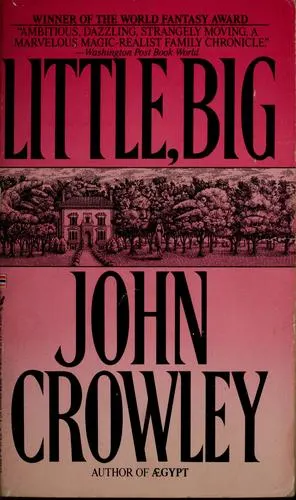
In Little, Big, every threshold enlarges the mystery: houses contain worlds, family stories become cosmologies, and revelation always seems to wait one room farther on.
If you liked Little, Big, you’ll love these
Not lookalikes — kindred books. Each one shares something essential with Little, Big, and we tell you exactly what.
Mirrlees’s 1926 masterpiece understands that the marvelous is most powerful when respectable people have spent generations pretending it does not exist. In prosperous Lud, fairy fruit is contraband and neighboring Fairyland an embarrassment—until the forbidden begins slipping back into domestic life.
Like Crowley, Mirrlees makes enchantment sensuous, dangerous, funny, and inseparable from longing. Her civilized surfaces conceal old songs, irrational customs, and truths that cannot be admitted in daylight. Once neglected, Lud-in-the-Mist has become a touchstone of literary fantasy, cherished by writers and readers who recognize how much later fantasy owes its wit and strangeness. It is the rare precursor to Little, Big that feels not primitive but inexhaustibly alive.
Three friends once attempted an occult act whose meaning remains elusive; afterward, its consequences seep through their ordinary adult lives. Harrison gives us glimpses of the Pleroma, an imagined or inaccessible realm whose beauty may be salvation, delusion, or both.
Where Crowley builds a vast, hospitable labyrinth, Harrison compresses comparable metaphysical yearning into a short, fierce novel. He is especially acute about the cost of wanting another world too badly: enchantment here mingles with failed love, aging, guilt, and the shabby persistence of hope. The book’s cult reputation rests on precisely this refusal to explain away its mystery. Few novels make the unattainable feel so radiant—or leave such an ache when the last page closes.
Alden Dennis Weer appears to be reminiscing about his Midwestern childhood, his relatives, local businesses, courtships, and the rooms of an old house. Yet from the opening image of a fallen tree and a disturbed grave, the calm voice feels fractionally wrong. Stories nest inside memories; incidental objects acquire hidden weight; omissions begin speaking louder than events.
This is kin to Little, Big not through fairies but through architecture. Wolfe constructs a book that seems larger inside than outside, requiring the reader to wander backward through it and reconsider every doorway. Peace has inspired an unusually devoted body of rereaders because it can transform completely without changing a word: pastoral memoir, family chronicle, ghost story, and something darker coexist within the same exquisite sentences. Anyone who loved discovering that Crowley’s tale was secretly shaping its reader should not miss Wolfe’s quieter, more treacherous house of memory.