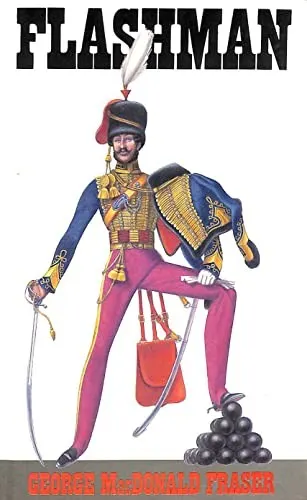
Books like Flashman
Flashman’s great trick is that the least trustworthy man in the Empire becomes its most brutally reliable witness: cowardice strips the glory from history while charm keeps us cheering the coward on.
If you liked Flashman, you’ll love these
Not lookalikes — kindred books. Each one shares something essential with Flashman, and we tell you exactly what.
This is Flashman’s great literary ancestor: a swaggering memoir in which an unscrupulous adventurer recounts his own career with sublime confidence, never noticing how thoroughly his boasts expose him. Barry is vain, predatory, resourceful and convinced that every betrayal proves his quality as a gentleman. The comedy lies in the widening gulf between the hero he describes and the scoundrel we see.
Thackeray’s eighteenth-century Europe is full of gambling, soldiering, social climbing and violence, but the real attraction is the voice—urbane, self-exonerating and wonderfully treacherous. Fraser admirers will recognize the peculiar pleasure of being trapped inside a rascal’s logic while remaining several moral steps ahead of him. Celebrated anew through Stanley Kubrick’s film, the novel itself is sharper, funnier and more intimate: anyone interested in Flashman’s lineage should meet the magnificent fraud who helped make him possible.
Farrell offers no Flashman substitute; instead, he supplies something rarer—the same exhilarating demolition of imperial self-respect. As a British colonial community in India prepares to defend itself, cherished ideas about progress, class, Christianity and English superiority meet heat, hunger, fear and physical reality. Farrell’s comedy is exquisitely dry, then suddenly savage.
Winner of the Booker Prize and widely regarded as the finest volume of Farrell’s Empire Trilogy, the novel combines meticulous historical texture with an almost slapstick understanding of how people behave under pressure. Its officials and idealists cling to ceremony while their grand abstractions become increasingly absurd. A Flashman reader will relish the refusal to prettify empire, but may be surprised by the pathos beneath the ridicule. It is one of the essential comic historical novels: immensely entertaining, morally alert and impossible to dismiss as mere spoof.
If what you love most is Flashman’s abundance—the scrapes, impostures, bawdy reversals, mock-heroic rhetoric and sense that history is a carnival run by cheats—Barth’s exuberant picaresque is irresistible. Its hero, Ebenezer Cooke, sails toward colonial Maryland determined to preserve both his innocence and his grand poetic vocation. The world immediately begins testing the practicality of both ambitions.
Barth writes with learned precision and anarchic delight, turning the conventions of old adventure tales inside out without sacrificing their momentum. The book is packed with forged identities, elaborate yarns, verbal duels and magnificently disreputable company; unlike Flashman, its protagonist is naïve rather than cynical, which lets Barth attack hypocrisy from the opposite direction. A landmark of American postmodern fiction, it has inspired unusually devoted readers because beneath its formidable size and cleverness it is riotously alive. Missing it means missing one of the few historical comedies audacious enough to match Fraser for sheer narrative mischief.