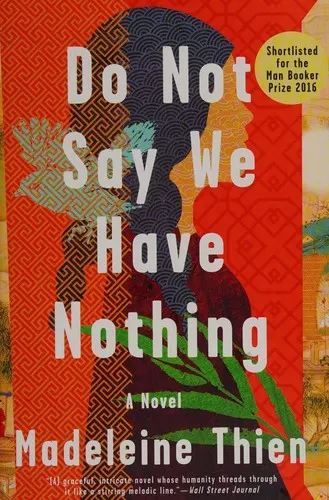
Books like Do Not Say We Have Nothing
Human Acts compresses historical catastrophe into a fierce chorus; Austerlitz approaches it through one man’s slow, haunted recollection. Along with The Eighth Life, these novels share Madeleine Thien’s gift for making memory both an artistic form and a moral obligation.
If you liked Do Not Say We Have Nothing, you’ll love these
Not lookalikes — kindred books. Each one shares something essential with Do Not Say We Have Nothing, and we tell you exactly what.
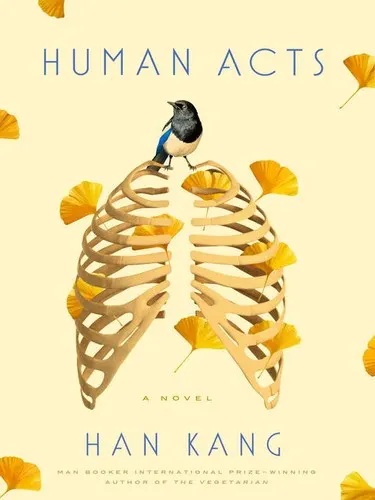
In the aftermath of the 1980 Gwangju uprising, a boy searches among the bodies gathered in a gymnasium for his missing friend. From that devastating opening, Han Kang creates a polyphonic novel about state violence and the people who must carry its memory.
Like Do Not Say We Have Nothing, it refuses to reduce history to either statistics or heroic myth. Voices intersect across time; private tenderness survives amid ideological brutality; art and testimony become ways of restoring individuality to the dead. Han’s prose, translated with crystalline force by Deborah Smith, is more compressed than Thien’s, but equally alert to beauty’s persistence under terror. Now that Han is a Nobel laureate, this remains one of the clearest demonstrations of why: a brief novel with the moral and emotional magnitude of an epic.
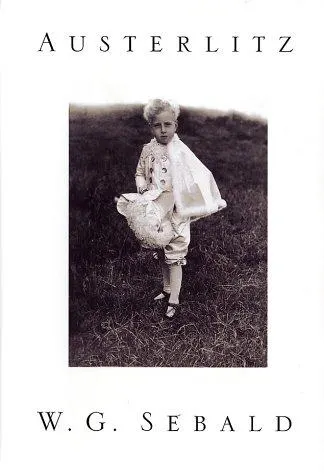
A narrator meets the enigmatic Jacques Austerlitz in an Antwerp railway station and gradually becomes the recipient of his fragmentary memories. The resulting narrative moves through railway halls, libraries, photographs and half-recovered impressions, as though the past were hidden inside the structures of the present.
Readers drawn to Thien’s Book of Records will recognize Sebald’s fascination with incomplete archives: what survives, what vanishes, and how a life might be reconstructed from damaged evidence. His immense, winding sentences reproduce the movement of memory itself, while the photographs embedded in the text make documentation feel both persuasive and untrustworthy. Winner of the National Book Critics Circle Award and widely regarded as Sebald’s masterpiece, Austerlitz is one of the essential novels about the shape absence leaves behind.

A woman begins telling her niece the story of their Georgian family, reaching back through generations whose desires, talents and betrayals become entangled with the Soviet century. At more than nine hundred pages, The Eighth Life has the amplitude to make history feel not like background but like weather—something that enters homes, rearranges loyalties and alters what descendants can know about one another.
Its kinship with Do Not Say We Have Nothing lies especially in its devotion to transmission. Stories are inherited imperfectly; family legends conceal wounds; political upheaval reverberates through marriages, artistic ambitions and parent-child bonds. Yet Haratischvili writes with tremendous narrative momentum, turning a vast genealogy into compulsive reading. Longlisted for the International Booker in Charlotte Collins and Ruth Martin’s translation, it is the rare family saga whose scale feels earned: once inside it, you do not merely observe a century—you live among the people it changed.