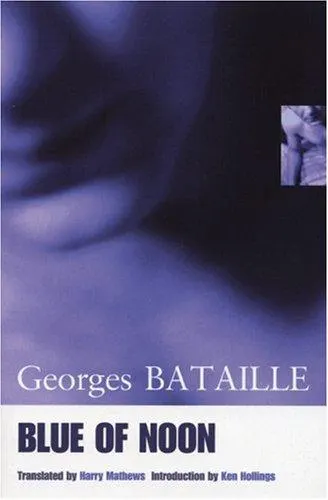
Books like Blue of Noon
Blue of Noon knows that erotic abasement and historical disaster are not parallel crises: at their darkest point, they become the same appetite.
If you liked Blue of Noon, you’ll love these
Not lookalikes — kindred books. Each one shares something essential with Blue of Noon, and we tell you exactly what.
Lowry’s modernist masterpiece shares Bataille’s ability to make self-destruction feel both sordidly private and historically immense. On the Day of the Dead in 1938, an alcoholic former British consul wanders through Mexico while Europe moves toward war and his estranged wife attempts to reach him. Drink does not soften reality; it turns every landscape, conversation, and political omen incandescent.
The consul’s ruin has the same terrible grandeur as Troppmann’s: lucid enough to recognize catastrophe, compulsive enough to court it. Lowry’s prose is denser and more symphonic than Bataille’s, but it generates a comparable fever—the sensation that desire, shame, and history are conspiring toward one irreversible moment. Long revered as one of the great novels of the twentieth century, Under the Volcano is the essential next book for anyone who found Blue of Noon intoxicating rather than merely shocking.
In The Skin, liberation itself arrives diseased. Malaparte’s narrator moves through Allied-occupied Naples, where hunger and defeat have made bodies, loyalties, and dignity negotiable. The book’s grotesqueries are not decorative provocations: like Bataille’s obscenity, they expose the humiliating material beneath political ideals.
Malaparte is colder, more theatrical, and savagely funny. He can make a banquet, a uniform, or a courteous exchange suddenly reveal an entire civilization’s moral decomposition. The novel caused scandal on publication and remains notorious, yet its lasting force comes from its refusal to divide victimhood neatly from corruption. Blue of Noon ends the distinction between erotic horror and political horror; The Skin carries that insight through a devastated city with unforgettable audacity.

Ice transforms the union of desire and catastrophe into a lucid nightmare. An unnamed man pursues a fragile young woman across a world threatened by advancing walls of ice; governments fracture, violence becomes ordinary, and geography obeys obsession rather than reason. Kavan never allows the reader the comfort of deciding where psychological compulsion ends and apocalypse begins.
What links it to Blue of Noon is less its extremity than its moral instability. The pursuer’s tenderness cannot be separated from possession, and beauty repeatedly hardens into cruelty. The crystalline prose is the opposite of Lowry’s abundance or Malaparte’s spectacle: brief, white, hypnotic, with every scene seeming already frozen in memory. Championed by J. G. Ballard and preserved as a cult classic, Ice is one of the few novels that can follow Bataille into the marriage of erotic fixation and collective doom without becoming an imitation.