Author
Books like Robertson Davies
3 books we recommend to Robertson Davies readers, drawn from Fifth Business — each with the reason why.
If you loved Fifth Business
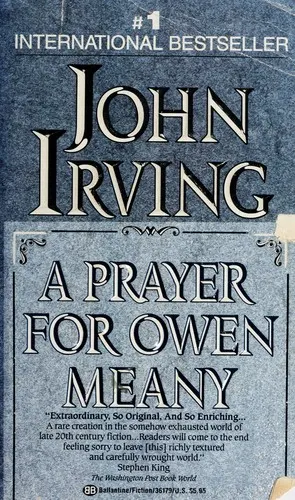
Irving begins, as Davies does, with an accident that becomes a lifelong spiritual problem. His narrator looks backward from adulthood, trying to understand his complicity, his strange friend Owen, and the possibility that coincidence may actually be providence.
This is not merely another eccentric small-town chronicle. Like Dunstan Ramsay, Owen occupies an ambiguous territory between holy fool, performer, victim, and agent of destiny. Irving balances broad comedy with accumulating metaphysical force, making absurd incidents feel charged with meaning without demanding easy belief. One of Irving’s most passionately loved novels, it offers the particular pleasure of watching an entire life click gradually—and devastatingly—into pattern.
If the theatrical magic, masks, and Jungian undercurrents of Fifth Business captivated you, The Magus turns those elements into an elaborate psychological ordeal. A restless young Englishman takes a teaching post on a Greek island and falls under the influence of a wealthy, enigmatic man whose stories and staged mysteries steadily erode the boundary between reality and performance.
Fowles makes reading itself feel like interpretation under pressure: every symbol tempts you, every revelation may be another disguise, and the protagonist’s vanity is exposed with almost ceremonial precision. The novel became an enduring cult favorite because its atmosphere is nearly impossible to shake. Few books so seductively reproduce the feeling that someone has designed a myth specifically to reveal you to yourself.
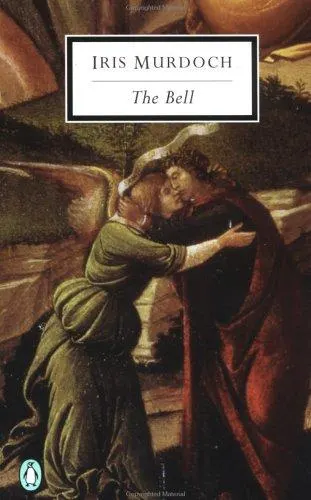
Murdoch’s celebrated moral comedy follows a group of imperfect people gathered around a lay religious community, each bringing private desires into a place devoted to spiritual discipline. At its center stands a legendary bell whose significance keeps changing according to who contemplates it.
A lover of Davies will recognize Murdoch’s delight in learned talk, grotesque comedy, religious symbolism, and motives that refuse to remain tidy. Yet her special gift is to show how badly people misunderstand themselves even when they are intelligent, sincere, and hungry for goodness. Widely regarded as one of her most inviting novels, The Bell is funny, sensuous, and morally exacting—the kind of book whose symbols continue sounding long after its human schemes have collapsed.