Books like Titus Groan
Gormenghast is not merely where Titus Groan happens: it is the book’s ruling mind, shaping every body, ritual, joke and menace within it. These three novels likewise make style and atmosphere feel like forces of nature.
If you liked Titus Groan, you’ll love these
Not lookalikes — kindred books. Each one shares something essential with Titus Groan, and we tell you exactly what.
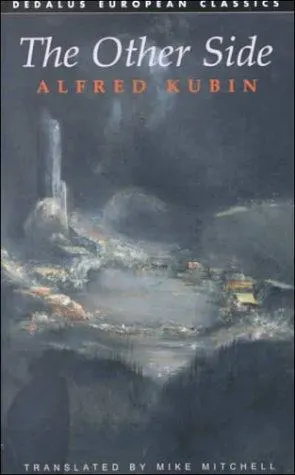
A draughtsman is invited to settle in a sealed “Dream Realm” assembled from old European buildings and governed by an elusive sovereign. Yet the real kinship with Peake lies deeper than the enclosed setting: Kubin makes architecture expressive, crowds individually grotesque, and decay almost sentient.
Kubin was a major illustrator, and his only novel—published in 1909 with his own drawings—has the feverish precision of an artist who can make every doorway and face look ominously significant. The Realm’s accumulating disorder mixes nightmare with mordant comedy, much as Gormenghast’s absurdities never dispel its dread. A landmark of fantastic literature and an important precursor to later European surrealism, The Other Side is one of the few novels whose world can linger in the mind like Peake’s castle.
For the reader who loved Peake’s luxuriant grotesquerie, Donoso offers something fiercer: a baroque novel in which servants, aristocrats, old women, monsters and decaying institutions seem to exchange shapes under pressure. Its sentences crowd the reader with voices, bodies, superstitions and hierarchies until social order itself feels diseased.
Donoso’s masterpiece, one of the great novels of the Latin American Boom, has Peake’s gift for turning caricature into metaphysics. Rank is never merely rank; deformity, costume and ceremony reveal how people invent identities and imprison one another inside them. It is darker and more destabilizing than Titus Groan, but it rivals Peake in imaginative density. Anyone drawn to Gormenghast’s sense that an entire civilization is rotting beautifully should experience this extraordinary book.
Carrington catches the side of Titus Groan that recommendations often neglect: its wicked comedy. Ninety-two-year-old Marian Leatherby receives a hearing trumpet, discovers what her family intends for her, and enters a world of eccentric inmates, preposterous authority and solemnly administered nonsense.
The prose is lucid and deadpan even as the imagination becomes gloriously ungovernable. Carrington, a celebrated Surrealist painter as well as a writer, gives every person, building and ceremony an emblematic strangeness without reducing anyone to a symbol. Marian’s alert, unsentimental voice also supplies what Gormenghast’s ritual victims rarely possess: the possibility of laughing authority out of power. Long cherished as a cult classic, The Hearing Trumpet is that rare visionary novel whose wildness feels exact rather than arbitrary.