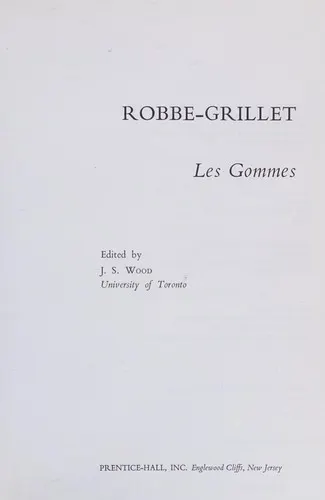
Books like The Erasers
Where The Erasers turns a murder inquiry into a trap laid by time, Michel Butor’s Passing Time turns a city diary into a maze whose map keeps changing under the reader’s hand.
If you liked The Erasers, you’ll love these
Not lookalikes — kindred books. Each one shares something essential with The Erasers, and we tell you exactly what.
A French clerk arrives in the grim English city of Bleston and begins recording his stay, hoping to impose order on a place he cannot decipher. Butor fragments the diary’s chronology so that recollection, investigation, and composition continually interfere with one another. As in The Erasers, apparent clues become distortions, and the attempt to reconstruct events may be what makes them unintelligible.
Winner of the Prix Fénéon and a landmark of the nouveau roman, Passing Time has the rare distinction of being formally formidable and sensuously oppressive: Bleston’s streets, smoke, maps, and stained glass acquire the force of a hostile consciousness. If Robbe-Grillet made you enjoy losing your bearings while watching the machinery of narrative operate, Butor’s magnificent urban labyrinth is indispensable.
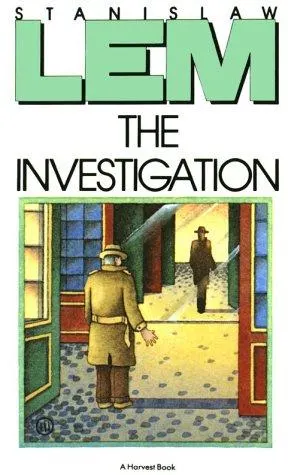
Corpses are vanishing from English morgues, yet every effort to treat the disappearances as a conventional crime produces only incompatible facts. Lem gives Lieutenant Gregory the habits of a detective and then places him in a world where causation itself may be an illusion generated by the mind’s hunger for patterns.
The pleasure here lies in watching several kinds of explanation—police logic, statistics, metaphysics—compete without any one of them securely mastering reality. Lem, celebrated chiefly for speculative fiction, is at his most slyly philosophical in this early novel: the procedural remains tense even as it becomes an assault on the assumptions that make procedures possible. Readers who loved The Erasers for turning detection into an epistemological practical joke will find The Investigation uncannily exact and deeply unsettling.
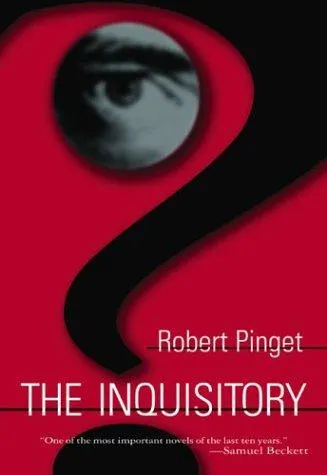
Almost entirely composed of questions and answers, The Inquisitory records an interrogation of an elderly servant about the inhabitants of a country estate. His testimony pours out in names, rooms, errands, scandals, corrections, and evasions; each detail seems precise, yet the total picture grows less stable with every clarification.
Pinget’s tour de force, awarded the Prix des Critiques, shares Robbe-Grillet’s distrust of explanatory storytelling but achieves it through a radically different music: not cool visual surfaces, but a compulsive, funny, exhausted human voice. The unnamed questioner keeps demanding coherence, while memory keeps producing texture instead. It is one of the great novels of unreliable knowledge—a book in which uncertainty becomes not a deficiency to solve but an atmosphere to inhabit.