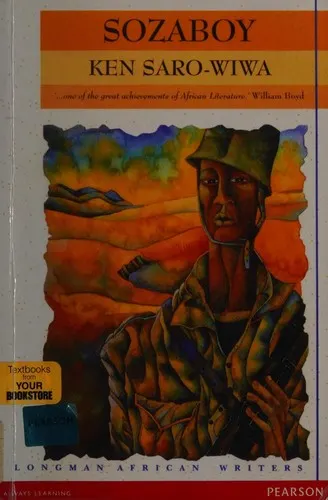
Books like Sozaboy
And what lingers is not only Mene’s fate, but the audacity of making damaged language tell the truth that official language conceals. These three novels share that blend of verbal invention, innocence, black comedy, and political horror.
If you liked Sozaboy, you’ll love these
Not lookalikes — kindred books. Each one shares something essential with Sozaboy, and we tell you exactly what.
Birahima, a West African boy swept into militia life, narrates with four dictionaries beside him, defining grand adult words even as he curses the adults who hide brutality inside them. Like Mene’s “rotten English,” his unruly speech is both comic performance and moral instrument: language supposedly marks him as ignorant, yet it lets him expose warlords, missionaries, and political slogans with devastating clarity.
Frank Wynne’s translation preserves the novel’s abrasive wit and hybrid rhythms. Winner of both the Prix Renaudot and the Prix Goncourt des Lycéens, it is the closest thing to a spiritual companion to Sozaboy—and far too singular to be treated merely as another child-soldier novel.
Okolo returns to his community searching for an elusive moral “it” and finds himself opposed by people who prefer obedience, wealth, and comfortable falsehoods. The story has the concentrated force of a fable, but its true drama occurs inside its sentences: Gabriel Okara bends English around Ijo syntax and patterns of thought, making familiar words feel newly strange.
Published in 1964, The Voice is a landmark of African modernist experimentation and an essential predecessor to Saro-Wiwa’s linguistic rebellion. Where Sozaboy invents a voice that official English cannot contain, Okara turns English inside out until it carries another culture’s consciousness. Missing it means missing one of the boldest early answers to the question Sozaboy asks: who owns the language in which power speaks?
Young Aleksandar tries to hold his Bosnian town together through stories: family legends, lists, jokes, extravagant inventions, and corrections to reality. His voice is irrepressibly playful, but war gradually puts terrible pressure on that playfulness. As in Sozaboy, comedy does not soften catastrophe; it records the mind’s refusal to accept the murderous logic adults call normal.
Stanišić’s German Book Prize–shortlisted debut announced a major stylist, and Anthea Bell’s translation catches its breathless changes of register. The novel understands something Saro-Wiwa understood perfectly: when public language has become poisonous, a seemingly naïve storyteller may be the only reliable witness left.