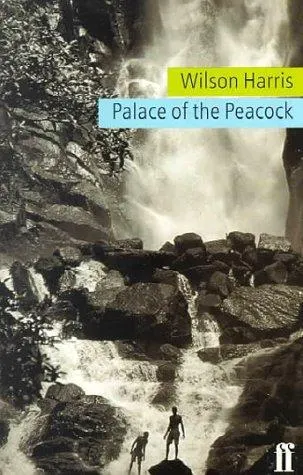
Books like Palace of the Peacock
—because Harris’s real achievement is not the voyage itself but the way language dissolves the borders between history, dream, death, and consciousness, these three novels offer similarly transformative reading experiences.
If you liked Palace of the Peacock, you’ll love these
Not lookalikes — kindred books. Each one shares something essential with Palace of the Peacock, and we tell you exactly what.
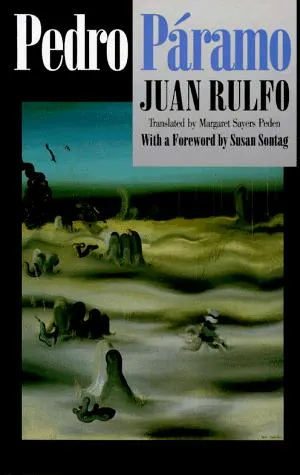
Juan Preciado arrives in Comala looking for the father he has never known, only to find a town made of heat, silence, and murmuring voices. Like Harris, Rulfo removes the ordinary signposts almost imperceptibly: speakers merge, chronology folds, and the distinction between memory and physical presence ceases to be useful.
This Mexican masterpiece has the density of myth despite being astonishingly short. Its account of power and dispossession emerges through fragments rather than explanation, compelling the reader to assemble a communal tragedy from echoes. Gabriel García Márquez credited it with breaking his creative impasse; generations of readers have returned to it because its haunted architecture becomes clearer—and stranger—with every rereading. Few novels come closer to the concentrated, spectral force of Palace of the Peacock.
An affluent sculptor enters the recently vacated room of her maid and finds her secure sense of reality beginning to fail. That confined premise opens into an immense metaphysical ordeal. Lispector’s narrator tests every word she uses, contradicting herself, circling back, and pushing beyond the comfortable fiction of a stable human identity.
A reader responsive to Harris’s demanding, incantatory prose will recognize the exhilarating risk: language is not describing an experience but creating one that may undo both narrator and reader. Yet Lispector reaches this extremity without Harris’s geography, historical cast, or ensemble voices; she proves that an entire cosmos can erupt inside one room. A cornerstone of Lispector’s formidable international reputation, this is the rare novel whose difficulty feels inseparable from its revelation.
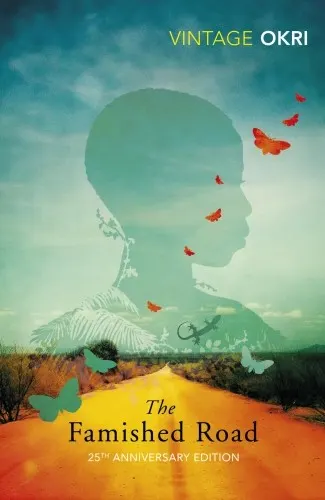
Azaro, a spirit child repeatedly drawn toward the world of the dead, chooses to remain with his struggling parents in a turbulent Nigerian community. Through his eyes, political rallies, family quarrels, hunger, animals, spirits, and metamorphoses occupy the same vivid plane. The supernatural never decorates reality; it exposes pressures that conventional realism cannot hold.
Where Harris is compressed and vertiginous, Okri is abundant: scenes proliferate, sensations crowd the page, and history arrives as a fever of competing visions. Both writers make colonial inheritance and political violence felt through unstable perception rather than tidy argument, while preserving flashes of comedy, tenderness, and wonder. Winner of the Booker Prize and the opening of a celebrated trilogy, The Famished Road is a vast, intoxicating novel for anyone who wants Harris’s visionary intensity expanded into a whole teeming world.