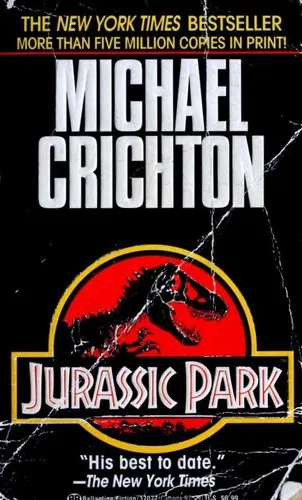
Books like Jurassic Park
In each of these books, human certainty stands inside a ring of blinking instruments while the living world quietly rewrites the rules.
If you liked Jurassic Park, you’ll love these
Not lookalikes — kindred books. Each one shares something essential with Jurassic Park, and we tell you exactly what.
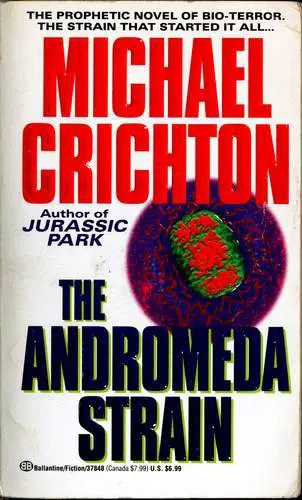
A military satellite falls near an Arizona town whose inhabitants have suddenly died, and a team of scientists descends into a secret underground laboratory to identify what came back with it. Crichton turns sterilization procedures, diagnostic tests, and branching hypotheses into instruments of suspense.
What connects it most deeply to Jurassic Park is its understanding that disasters rarely need one grand mistake: tiny assumptions can align until an immaculate system becomes a trap. The novel that made Crichton famous also helped define the modern techno-thriller. If Jurassic Park made you crave another machine built from credible science, human overconfidence, and merciless timing, this is the essential next book.
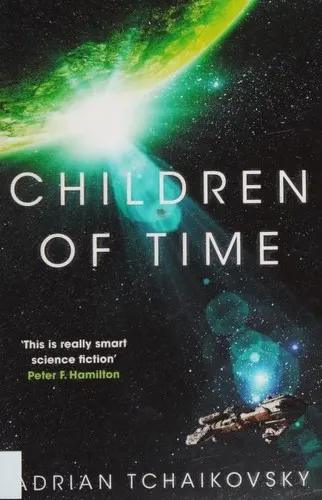
An ambitious experiment meant to accelerate intelligence on a terraformed planet goes wrong—but not in the way its architect expects. Across immense stretches of time, Tchaikovsky follows the astonishing consequences while a failing human ark searches for somewhere to survive.
Jurassic Park’s dinosaurs are compelling because they are never merely monsters: they learn, coordinate, and expose the poverty of their creators’ imagination. Children of Time takes that fascination with nonhuman intelligence much further, making evolution itself dramatic without sacrificing momentum or wonder. Winner of the Arthur C. Clarke Award and the beginning of a widely loved series, it offers the rare exhilaration of watching genuinely alien minds become comprehensible.
At first the incidents seem disconnected: strange organisms appear, marine animals behave inexplicably, and disasters begin along the world’s coasts. Scientists in several disciplines slowly recognize that these are not isolated curiosities but parts of a planetary pattern.
Schätzing builds suspense the way Crichton does at his best: observation becomes hypothesis, hypothesis becomes dreadful prediction, and every answer enlarges the danger. Marine biology, geology, climate, and engineering are not decorative research; they are the gears driving a vast cascade of failure. This German publishing phenomenon became an international bestseller because it delivers blockbuster scale while taking scientific reasoning seriously. Its accumulating sense that humanity has misunderstood the system surrounding it is pure Jurassic Park terror, expanded to an entire biosphere.