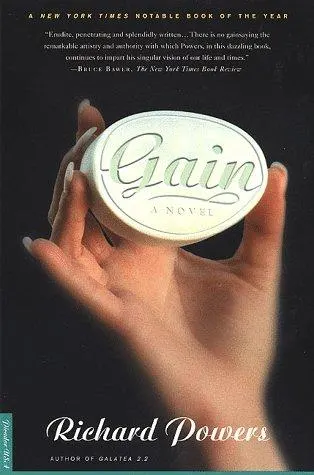
Books like Gain
Readers who love Gain tend to distrust novels that shrink public catastrophe to a single villain: they want fiction alive to systems, language, accumulated choices, and the vulnerable bodies caught inside them. These three make institutions feel eerily sentient without sacrificing human intimacy.
If you liked Gain, you’ll love these
Not lookalikes — kindred books. Each one shares something essential with Gain, and we tell you exactly what.

This cult American novel comes closest to Gain’s extraordinary sense that responsibility is everywhere and therefore almost impossible to locate. Dara passes restlessly among voices—conversations, broadcasts, arguments, stray testimony—until an entire community seems to be thinking aloud. The technique turns environmental and civic damage into something experienced collectively rather than packaged as one character’s moral lesson.
Selected by William H. Gass for FC2’s First Novel Prize, The Lost Scrapbook has inspired unusually fervent devotion despite remaining obscure. Its difficulty is purposeful: the reader must assemble connections that institutions and ordinary habits work to conceal. If Gain made you feel the novel could diagnose forms of causation unavailable to journalism or history, Dara’s book is indispensable.
Gaddis’s National Book Award winner is the great comic counterpart to Gain. An eleven-year-old discovers that modern finance can be manipulated through telephones, paperwork, and other people’s credulity; from there, capitalism seems to speak itself into existence. The novel is composed almost entirely of unattributed dialogue, with interruptions, misunderstandings, and sales pitches colliding at manic speed.
What makes JR more than satire is its refusal to place greed safely inside a few monsters. Everyone is improvising within systems whose momentum exceeds their understanding. Gaddis makes bureaucracy and commerce grotesquely funny while preserving the exhaustion and thwarted hopes of individual lives. Once its voices click into focus, the apparent chaos becomes one of fiction’s most astonishing feats of orchestration.
The Employees compresses into a haunting, crystalline novella questions that Gain unfolds across generations. A series of numbered workplace statements, taken aboard a distant spacecraft, records how human and humanoid employees respond to mysterious objects. Corporate language attempts to classify their sensations, loyalties, memories, and usefulness—but the testimony keeps exceeding the categories provided for it.
Shortlisted for the International Booker Prize in Martin Aitken’s translation, Ravn’s novel is both chillingly funny and unexpectedly tender. Its committee reports reveal how employment colonizes identity, while its fragmentary form makes personhood itself feel contested. Read it for the unnerving pleasure of watching administrative prose develop a soul—or expose the soul it has been trying to suppress.