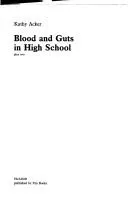
Books like Blood and Guts in High School
You want books that refuse to behave: novels that treat language, sexuality, and literary form as contested territory. These three carry Acker’s insurgent energy in sharply different directions.
If you liked Blood and Guts in High School, you’ll love these
Not lookalikes — kindred books. Each one shares something essential with Blood and Guts in High School, and we tell you exactly what.
Bellamy lets Dracula’s Mina Harker occupy her own body and write intimate letters to friends and lovers. The result is simultaneously novel, correspondence, gossip, sexual confession, and literary criticism—exactly the sort of unstable mixture that makes Acker feel dangerous.
A foundational work of New Narrative and now a cult classic, it turns appropriation into possession: a borrowed character becomes a means of speaking about desire, humiliation, friendship, and authorship without cleaning any of them up. Bellamy’s candor is funny, abrasive, and startlingly vulnerable. If Acker showed you that theory can have genitals and confession can be an act of sabotage, this is indispensable.

Dictee breaks narration into photographs, diagrams, translation exercises, prayers, historical documents, and fractured passages in several languages. Its subject is not merely identity but the violence involved in being made to speak—by colonizers, schools, religion, family, and literary convention.
Cha’s book is quieter than Acker’s, but no less radical. Where Blood and Guts in High School attacks the languages that imprison Janey, Dictee exposes the wounds and silences inside language itself. Published in 1982 and later recognized as a landmark of Asian American and experimental literature, it has influenced generations of writers and artists. Reading it changes what a page can seem capable of remembering.
Quin’s final novel tears through American consumer culture in a delirious pursuit involving an unnamed narrator, his ex-wife, and her new husband. But the chase is only scaffolding: advertisements, questionnaires, psychoanalytic jargon, pulp fantasy, and illustrations continually hijack the book.
The pleasure lies in its manic velocity and refusal of ownership. Quin takes the ready-made languages of commerce and respectability and makes them incriminate themselves, much as Acker steals canonical and pornographic forms to expose the power inside them. Long a cult figure of the British avant-garde, Quin now looks startlingly ahead of her time. Tripticks is savage, comic, visually unruly—and proof that the punk novel existed before punk had a name.