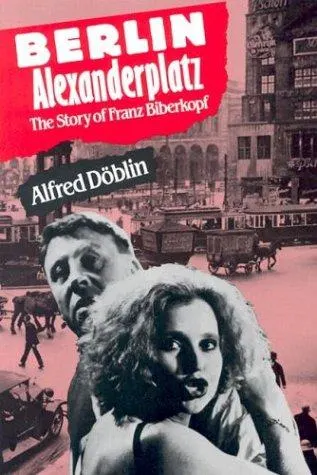
Books like Berlin Alexanderplatz
After Döblin’s pounding trams, newspaper cries, biblical echoes, pub talk, and battered Franz Biberkopf, an ordinary realist novel can feel unnaturally quiet. What satisfies now is fiction in which the city speaks through every register at once—and the individual must struggle not to disappear inside its noise.
If you liked Berlin Alexanderplatz, you’ll love these
Not lookalikes — kindred books. Each one shares something essential with Berlin Alexanderplatz, and we tell you exactly what.
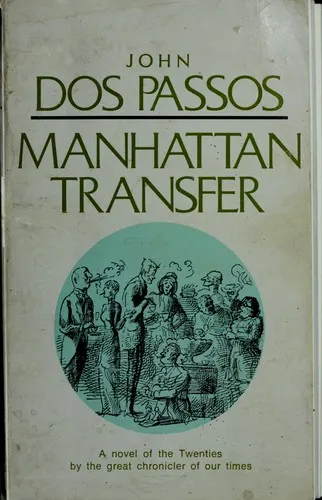
Here, as in Döblin, the metropolis is not scenery but the novel’s dominant intelligence. Dos Passos cuts between strangers, advertisements, popular songs, headlines, overheard speech, and fleeting private crises until New York seems to be dreaming its inhabitants.
The cast is broader and more dispersed than Berlin Alexanderplatz’s, but the effect is similarly propulsive: lives collide, separate, and become part of an urban rhythm no one controls. Published in 1925, Manhattan Transfer became a landmark of modernist montage and remains one of the rare novels whose form actually feels like a crowded city. If Döblin taught you to enjoy fiction assembled from the street’s debris, this is essential reading.

Petersburg offers the hallucinatory side of Döblin’s achievement: a city that presses into the mind until streets, political schemes, family tensions, and private terrors become almost indistinguishable. A young revolutionary receives a dreadful assignment involving his own father; around them, imperial Petersburg expands and contracts like a feverish thought.
Bely’s prose is incantatory, grotesquely funny, and charged with repeated colors, shapes, and sounds. Where Döblin uses montage to expose the machinery of modern life, Bely makes modern life feel metaphysically unstable. Nabokov famously counted Petersburg among the century’s greatest prose masterpieces, and its reputation is deserved: it is one of modernism’s strangest, most intoxicating cities, and once entered, impossible to confuse with any other.
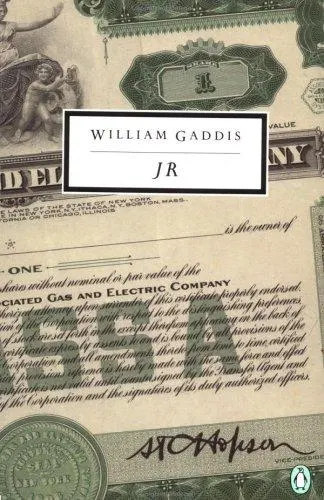
Read J R for the exhilarating sensation of being dropped into a social machine already running at full speed. Gaddis largely removes conventional narration and constructs the novel from overlapping voices—telephone calls, meetings, lessons, sales pitches, interruptions—forcing the reader to identify people and motives from verbal tics and fragments. The cacophony is comic, exhausting, and brilliantly exact.
This is Döblin’s polyphonic method carried into corporate America: language itself becomes a system through which money, institutions, and accidents govern human lives. Winner of the National Book Award and sustained by unusually devoted readers, J R is demanding in the best way. Once its voices click into focus, it delivers a pleasure few novels even attempt: the discovery of order inside overwhelming noise.