Author
Books like Eleanor Arnason
3 books we recommend to Eleanor Arnason readers, drawn from A Woman of the Iron People — each with the reason why.
If you loved A Woman of the Iron People
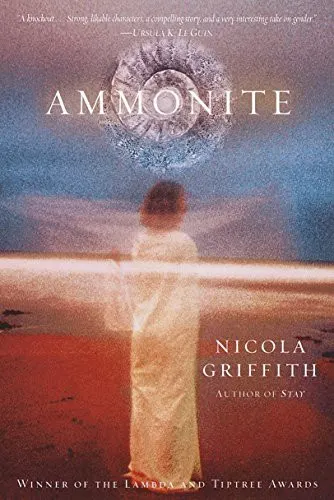
Anthropologist Marghe Taishan arrives on a planet whose communities have developed beyond the categories her employers use to understand them. Like Arnason, Griffith treats fieldwork as a moral practice: Marghe must listen to stories, learn kinship obligations, endure discomfort, and recognize knowledge that cannot be gathered from a safe observational distance.
Ammonite is more inward and sensuous than A Woman of the Iron People, particularly in its attention to landscape and embodied experience, but it shares Arnason’s refusal to make a women-centered society either a gimmick or a frictionless utopia. Every community contains disagreement, history, and compromise. Winner of both the James Tiptree Jr. and Lambda Literary awards, it is one of feminist science fiction’s essential novels—and its emotional force exceeds even its formidable ideas.
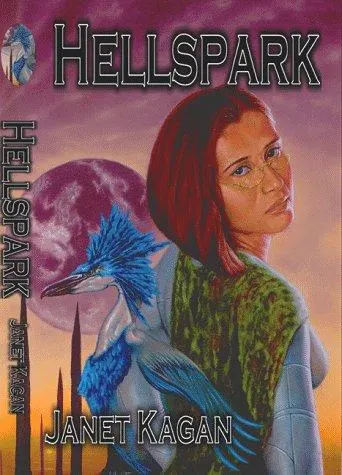
If you loved Arnason’s scenes of people slowly learning how to read one another, Hellspark turns that pleasure into an exhilarating linguistic mystery. Trader Tocohl Susumo joins a planetary survey divided over whether the indigenous Sprookjes are intelligent. The answer depends not on technology or conquest but on gesture, etiquette, posture, and the dangerous assumptions hidden inside apparently neutral standards.
Kagan is wonderfully alert to how culture inhabits the body: a movement that means courtesy to one person may be an insult to another. She also directs the anthropological gaze back at the survey team, making its human specialists seem as culturally peculiar as the beings they study. Witty, generous, and suspenseful without sacrificing intellectual rigor, Hellspark has endured as a word-of-mouth favorite because almost no other novel makes careful observation feel so adventurous.
Slonczewski’s ocean-dwelling Sharers possess a language, biology, and ethic built around reciprocity rather than domination. What links them to Arnason’s Iron People is not simply an unusual gender order, but the depth with which their values shape ordinary life: healing, argument, work, hospitality, and even the grammar through which they conceive action.
The novel introduces this culture through Spinel, a young outsider whose apprenticeship requires more than memorizing customs. He must confront the possibility that the Sharers’ apparent gentleness is a demanding form of strength. Slonczewski never turns them into a unanimous ideal; their debates give the society its credibility and political power. A Door into Ocean won the John W. Campbell Memorial Award, and deservedly so: it is a rare novel in which ecological imagination, rigorous world-building, and a radical theory of resistance become inseparable.