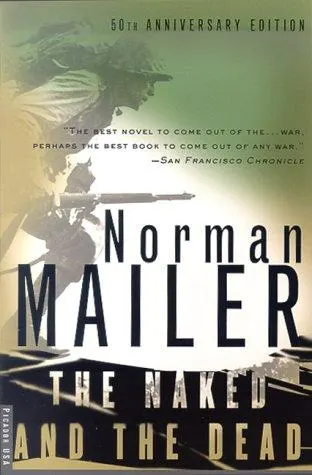
Books like The Naked and the Dead
How much choice can a person retain once war has reduced him to a frightened body inside a chain of command? These three novels pursue Mailer’s question with comparable psychological force and institutional clarity.
If you liked The Naked and the Dead, you’ll love these
Not lookalikes — kindred books. Each one shares something essential with The Naked and the Dead, and we tell you exactly what.
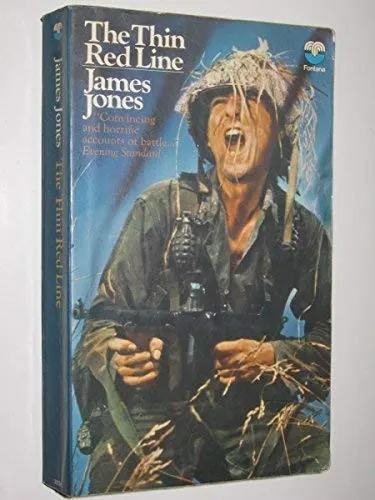
No novel comes closer to Mailer’s fusion of battlefield realism, shifting interior viewpoints, and philosophical unease. Following an American infantry company on Guadalcanal, James Jones moves from mind to mind—officers, veterans, cowards, idealists—until collective heroism dissolves into incompatible private experiences.
Jones, himself a Guadalcanal veteran, writes combat as sensory chaos while remaining fascinated by status, obedience, sex, fear, and the strange intimacy among men who may die together. Like Mailer, he refuses to let courage simplify anyone’s character. Widely regarded as one of the essential American novels of the Second World War, The Thin Red Line feels less like a conventional war story than an argument about what organized violence reveals—and destroys.
If General Cummings and the poisonous logic of military hierarchy fascinated you, The Caine Mutiny is indispensable. A young officer joins an aging minesweeper commanded by the erratic Captain Queeg, and what first appears to be a straightforward conflict between competence and authority becomes steadily more morally treacherous.
Wouk’s great achievement is to make procedure suspenseful: regulations, wardroom gossip, petty humiliations, and divided loyalties accumulate until every judgment carries consequences. The Pulitzer Prize–winning novel has remained durable because it denies readers the comfort of a clean verdict. It asks whether resistance to bad command is courage, vanity, panic, or some inseparable mixture—and then turns that question back on everyone involved.
Matterhorn has the mud, exhaustion, arbitrary orders, and lethal terrain of Mailer’s patrol sections, but its deepest kinship lies in the way ambition travels down a military hierarchy and becomes suffering for ordinary soldiers. A young Marine lieutenant in Vietnam must lead men whose lives are shaped not only by the enemy but by careerist officers, racial tension, hunger, disease, and impossible logistics.
Marlantes spent decades writing the novel after serving as a decorated Marine in Vietnam, and that long reckoning shows in its authority. The combat is ferocious, yet the book’s most memorable struggles concern trust: who deserves it, how commanders squander it, and what men owe one another when institutions fail them. Winner of the Center for Fiction First Novel Prize, Matterhorn has earned unusual devotion as a modern war novel because it makes endurance feel physical and moral at once.