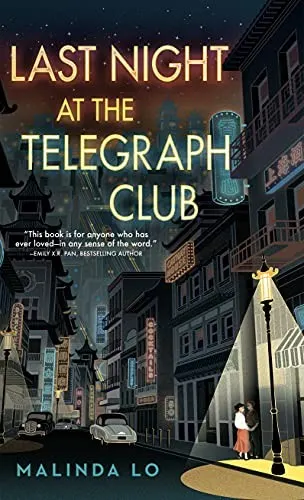
Books like Last Night at the Telegraph Club
A private spark keeps brightening inside Lily even as family, prejudice, and history press in around her; the result is tender, quietly suspenseful, and exhilarating whenever secrecy gives way to recognition. These three novels create that same sense of a life becoming possible.
If you liked Last Night at the Telegraph Club, you’ll love these
Not lookalikes — kindred books. Each one shares something essential with Last Night at the Telegraph Club, and we tell you exactly what.

In 1989 New York, Iranian immigrant Reza is terrified by his attraction to other boys—and by an era that has taught him to associate being gay with AIDS and death. Nazemian places him alongside Judy and Art, two vividly drawn friends whose loyalties give the novel its emotional pulse.
Like Malinda Lo, Nazemian understands that coming out is never only an individual decision: family expectations, race, friendship, politics, and the available models of queer life all shape what can be admitted. Yet this is no dutiful history lesson. It is ardent, messy, funny, and saturated with pop music, fashion, activism, and first love. Its deepest gift is the same one Lily finds at the Telegraph Club: proof that queer history contains not just persecution, but courage, style, solidarity, and joy.

Cameron Post’s voice is the attraction here: observant, dryly funny, wary, and intensely alive to every charged silence. Growing up in rural Montana after the sudden loss of her parents, Cameron learns to conceal her desire for girls while scrutinizing the adults who claim to know what a proper life should look like.
Danforth gives queer adolescence room to unfold at its real pace. Glances, friendships, movies, shame, and longing accumulate until they feel momentous; the landscape is rendered with the same precision Lo brings to 1950s San Francisco. Now regarded as a queer-YA touchstone—and the source of the Sundance-winning film—the novel earns its devoted readership through Cameron herself. Leaving her at the final page feels like leaving someone you have actually known.

Leda arrives in Buenos Aires from Italy in 1913 carrying a violin and discovers a city electrified by tango. To enter its male musical world, Leda becomes Dante, and De Robertis makes that act of reinvention feel dangerous, sensuous, and artistically liberating.
Where the Telegraph Club offers neon, comedy, and a forbidden dance floor, this Stonewall Book Award winner gives you cramped halls, feverish music, and the bodily thrill of becoming legible to yourself. De Robertis writes history from inside desire: gender and sexuality are not abstract subjects but forces felt through clothing, rhythm, risk, and performance. Sweeping without losing intimacy, it captures the intoxicating realization that an underground world may be more truthful than the respectable one above it.